

Specialized Maytag Appliance Repair in San Francisco
Mon–Sat: 8:00 AM – 7:00 PM
A flashing code on a Maytag range looks urgent, but most point to a control, sensor, latch or fan area. Learn how to read the code, what to write down and what to leave alone.
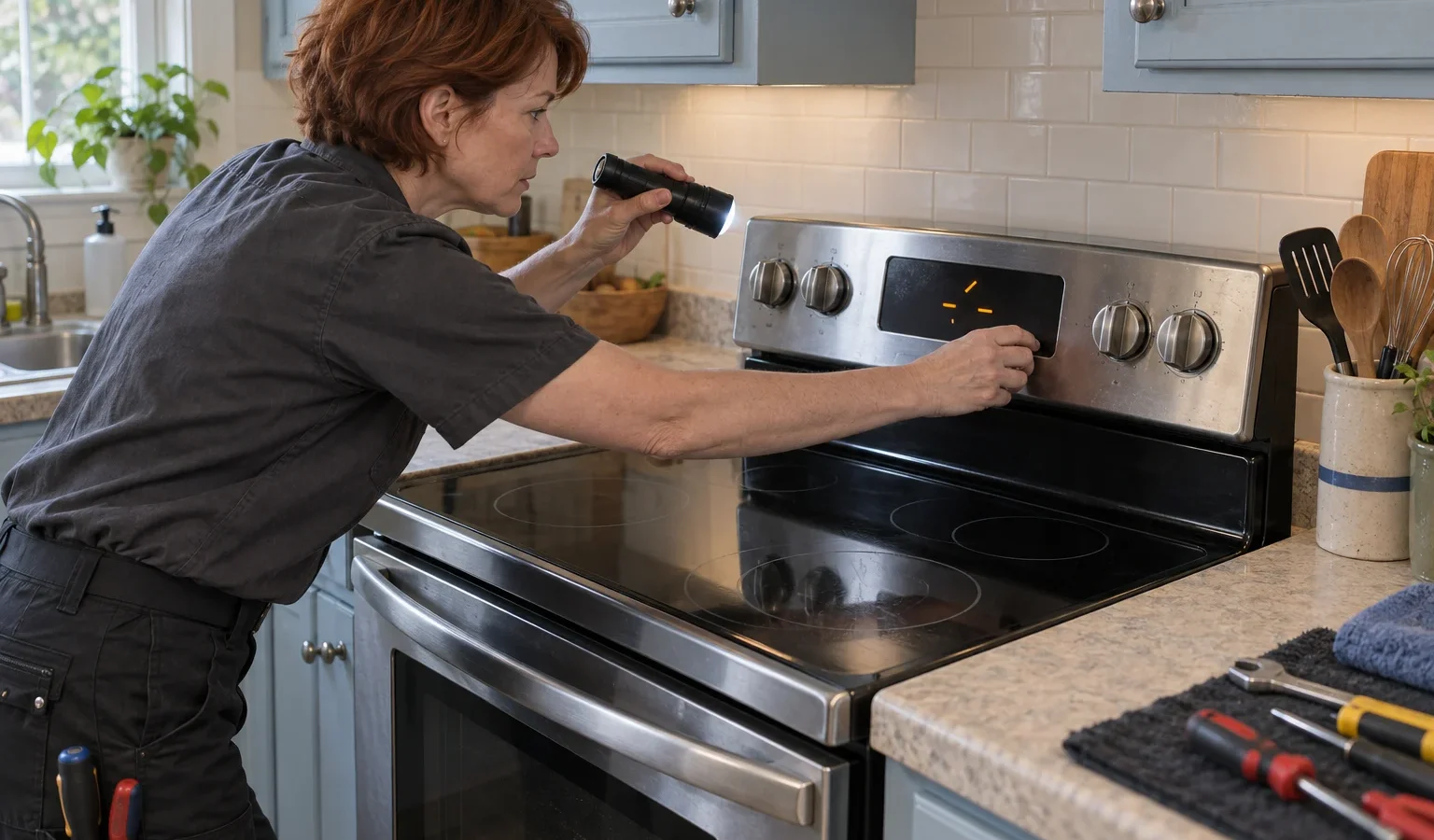
A range that suddenly shows letters and numbers is trying to tell you where it detected a problem. The code does not name a broken part; it names an area, and the same area can fail in several ways. Reading it correctly, and not wiping it before a technician sees it, makes the visit faster.
Maytag range codes come in a few visible styles. Some are a letter and a number, such as F5. Some use a space or dash after the first pair, such as F7 E5 or F1-A. Others start with a digit, such as 4D11 or 1C31. Copy it exactly, including the spaces, and note whether it appeared during a bake, a broil, a cleaning cycle or at idle. A code that appears only during self-clean is a different story from one that appears at power-up.
The 1C-series codes point at the electronics. 1C1C indicates a possible problem with the user interface or keypad, or the wiring. 1C31 points to the oven control or its wiring. Codes such as F03 and F06 also name the electronic control. Keypad faults sometimes follow a spill under the control panel, which is common on ranges used next to a busy sink.
A single power reset sometimes clears a one-off control hiccup. If the code returns within a day, the part needs to be diagnosed and not reset again and again.
1D11 and its neighbours point to the oven temperature sensor, the control, or the wiring between them. F3 E3 names the oven temperature sensor or its wiring. These show up with ovens that run cold, run hot or refuse to preheat, which is discussed in Maytag oven temperature off.
A latch fault is the most frequent group on the list. 4D11 points to the oven door latch assembly, the door switch or the wiring. F5, F1-A and F05 point to the same area. F5 E5 is different: it names the door hinges or door gasket. If the door has been slammed, hung on or loaded with a heavy pan while open, the hinge and gasket are worth mentioning to the technician.
4D21 points to an airflow restriction, the oven cooling fan or its wiring. F7 E5 and F8 E2 name the cooling fan or the wiring. A cooling fan that runs loudly or not at all, or a range pushed hard against a wall with the vents covered, deserves a look. Keep the area around the range free of cloths, trays and stored items.
FEE6 points to the main cavity bake element or the associated wiring, and FEE7 to the main cavity broil element. For a cold oven without a code, see Maytag oven not heating.
FC E1 describes a connected-appliance problem such as a time-out, a weak signal, the router or the Wi-Fi module. That one is mostly about the home network, so a router restart is a fair first step. F9E0 points to a mis-wired house or range power connection, which is more likely after a new install, a move or an electrical job in the kitchen.
Some codes in the Maytag list, such as 3D31, come with a reset or service instruction but no stated cause. For those, the display tells you something is wrong without telling you where, and a technician has to check the oven in person.
Do not open the back panel, pull connectors, or test live parts. If you smell burning or see sparks, switch the breaker off and leave the range off. If you smell gas, leave the home and call the gas utility or 911 from outside.
Many repeat codes trace back to everyday conditions and not to a defective range. Cleaning sprays aimed at the control panel seep behind the keypad. A self-clean cycle started with heavy grease in the cavity runs hotter and longer than the oven expected. A range pushed hard against the wall can pinch its own cord or gas flex. If a code returns at the same moment each time, such as during cleaning or right after a long roast, say so, because the pattern often points to the cause faster than the code does.
Property managers who handle several units often see the same code across buildings that share a range generation. A short list that pairs each unit’s model number with the code it showed lets us arrive with the right parts. Tenants should tell the manager rather than attempting a fix, since the range usually belongs to the building.
The same code can mean a different part on different generations, which is why the full model number matters; see how to find your Maytag model number. For a general overview go to Maytag range repair or Maytag ranges. A diagnosis comes first, a written estimate follows, and nothing is repaired without your approval. Models such as the Maytag MER8800FZ repair page and the Maytag MGR6600FZ repair page list the type of range these codes commonly appear on.
No. Meanings are consistent within a code, but the codes that appear depend on the control generation. Gas and electric ranges also show different sets.
A single power reset at the breaker may clear it. If it returns, the cause is still present and needs diagnosis.
F5 points to the oven door latch assembly, the latch switches or the wiring. It is often seen after a self-clean cycle or a door that does not close fully.
Usually it concerns the home network, such as a time-out or weak signal, or the Wi-Fi module. It does not affect basic cooking in most cases.
Not if the code relates to heat, a latch or a fan, or if you notice a burning smell. Switch the breaker off and book a diagnosis.
Share a few details and we’ll confirm an appointment. Prefer to talk? Call us and we’ll help right away.