

Specialized Maytag Appliance Repair in San Francisco
Mon–Sat: 8:00 AM – 7:00 PM
Heavy frost on the freezer walls or a sheet of ice behind the back panel signals that something in the defrost system or the door seal needs attention. Here is how to read it.
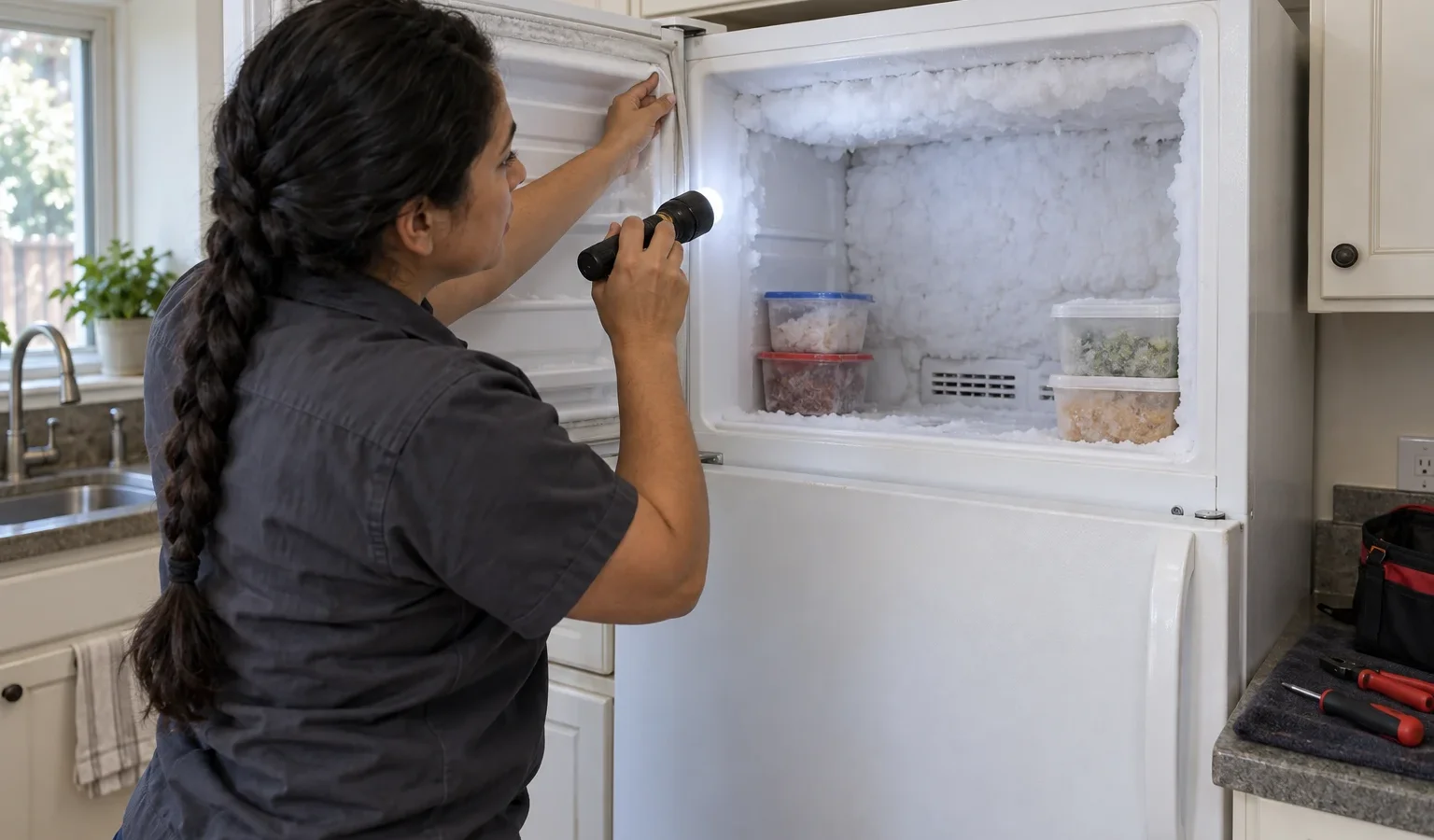
Open the freezer and see white fuzz creeping across the walls, or notice that the shelves are glued to the liner with ice, and you are looking at moisture that is freezing in the wrong place. A little frost near the door opening is ordinary. Heavy, spreading frost, or a solid sheet of ice that blocks air vents, is different, and it usually means one of three things: warm moist air is getting in, the defrost system is not clearing the evaporator, or airflow has been interrupted.
Frost concentrated around the door edge and on the items nearest the opening suggests a leaking door seal or a door that does not close fully. Frost on the back wall, behind a rear panel or covering the evaporator fins points to the defrost system. A coating on the freezer ceiling or around the vents suggests humid air entering through a cracked gasket or a drawer that rides open. When frost is on food only, in the form of ice crystals on packages, repeated warming and refreezing is the likely cause.
Sound adds to the picture. A freezer fan that begins to whine or scrape often has ice touching the blades, which is what happens once frost has grown thick enough to reach them. If the fridge side is warming while the freezer builds frost, read Maytag refrigerator not cooling as well, because the two conditions often travel together.
A freezer cools with an evaporator, a coil that gets very cold and collects moisture as frost. Left alone, that frost would choke the coil, so a defrost cycle periodically warms it with a heater and lets the meltwater drain away. A timer or control board decides when to start, and a sensor or thermostat decides when to stop. If any of those pieces fails, the heater may not run, may run too briefly, or may never shut off, and ice accumulates over days or weeks until air can no longer pass.
Start by checking the door line. Look for anything touching the gasket, then close the freezer and see whether it pulls shut with a soft pull or springs back. A light pressed against the closed door can reveal gaps at the corners of the gasket. Wipe the gasket with a damp cloth if it is sticky or dirty, because a gritty seal never seats well.
If the buildup is mild and you can see where it is, a controlled manual defrost may be sensible: empty the freezer into coolers, unplug the unit, leave the doors open and let it melt with towels around the base. Do not scrape, chip or use hot tools. Once the ice is gone, dry the compartment, plug the unit back in and watch how quickly frost returns. If it comes back within a couple of weeks, the cause is in the defrost system or the seal, not a one-time event.
Write down any flashing letter or light on the display. Our page on the flashing F indication describes what Maytag says about that signal for side-by-side units.
Do not stab at the ice with a screwdriver or an ice pick, since the evaporator tubing sits just behind the frost and a puncture is a sealed-system problem. Do not use a hair dryer on the rear panel, which can melt the foam and plastic, or aim a heater at the cabinet. Do not remove interior panels to look for the heater; those wires are live when the unit is plugged in. And if you smell something burning, switch off the breaker straightaway.
Humidity in the kitchen influences frost more than most people expect. Cooking steam in a closed galley, a laundry nearby in a flat with little ventilation and a garage unit in a damp coastal neighborhood all increase the moisture that finds its way into the freezer. Foggy summer mornings along the coast and open doors in a busy home make the effect worse. A refrigerator that is not level can also hold the door slightly open. We check leveling, door alignment, the gasket and the drain as part of the visit, then test the defrost system itself.
Chest-style storage habits matter too: packing the freezer so that food touches the vents blocks the circulation of cold air and adds to frost around those spots.
Whether the evaporator sits behind the freezer wall or in a drawer, and how the fresh-food side gets its air, depends on the layout. A French-door model like the Maytag MFI2570FEZ and a side-by-side like the Maytag MRSF4036PZ place the evaporator differently, so having your model number ready helps. If you do not know where to find it, read how to find your Maytag model number.
Schedule a diagnosis if frost returns after a manual defrost, if the back wall is solid ice, if the fan is noisy, or if the fresh-food side has begun to warm. We find the cause before repairing, put the estimate in writing and wait for your approval. See Maytag refrigerator repair and the Maytag refrigerators overview for what we handle.
A light dusting near the door is normal. Thick coats, ice sheets or frost that blocks the vents are not.
You should not need to. If you are defrosting regularly, the unit has a defrost or door problem that deserves a diagnosis.
That is where the evaporator sits behind the panel. Ice there usually means the defrost heater, sensor or control is not completing a cycle.
Yes. A leaking seal pulls in moist room air all day, and the moisture freezes on the nearest cold surface.
Food covered in crystals is usually safe but lower in quality. If it thawed and refroze, judge it carefully and discard anything doubtful.
Share a few details and we’ll confirm an appointment. Prefer to talk? Call us and we’ll help right away.