

Specialized Maytag Appliance Repair in San Francisco
Mon–Sat: 8:00 AM – 7:00 PM
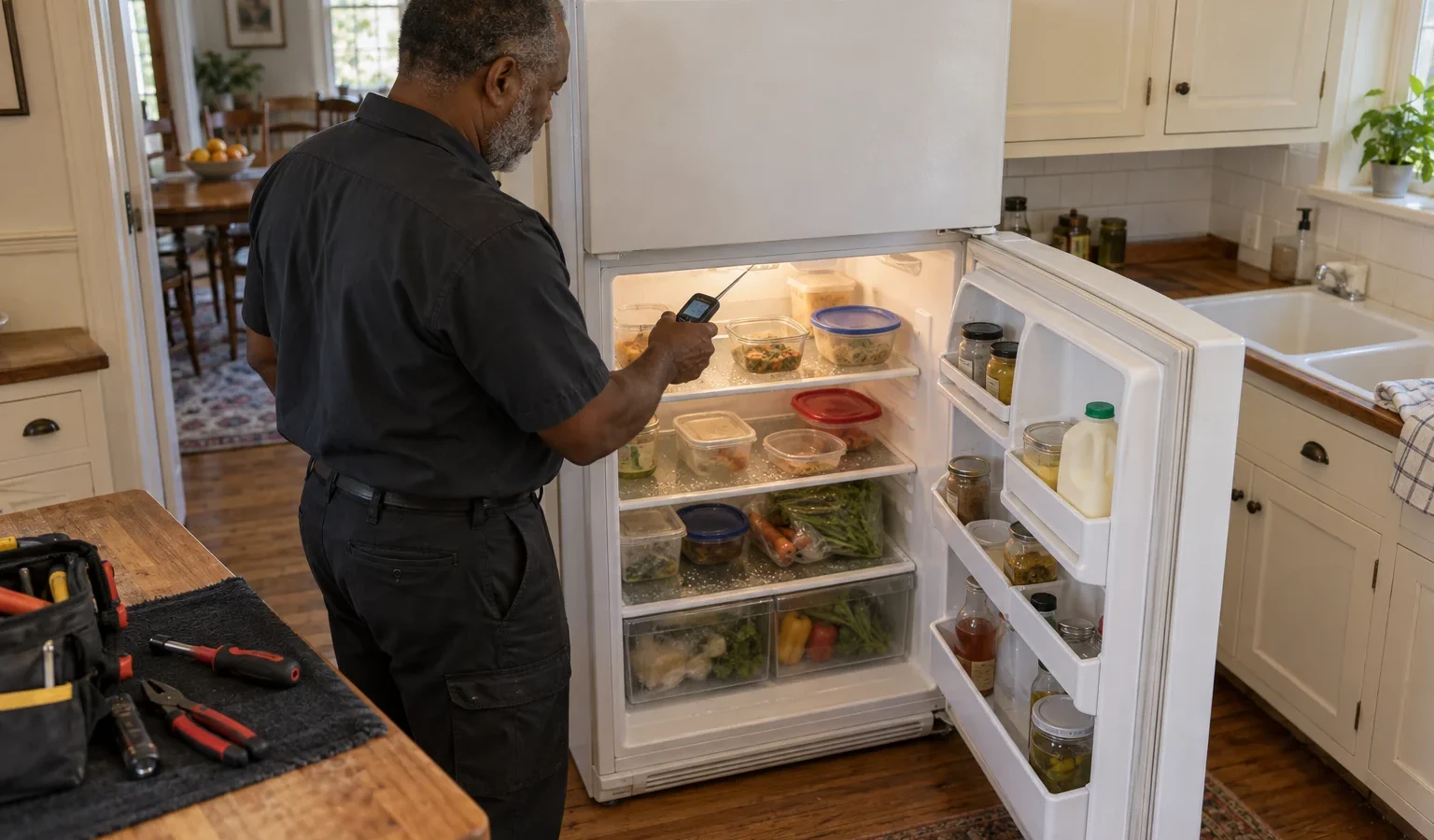
A Maytag refrigerator that runs but stays warm usually points to airflow, defrost or a sealed-system problem. Here is how to sort out which one, and what you can safely check first.
A Maytag refrigerator that sounds like it is working but leaves milk lukewarm is one of the most common calls we get from flats, condos and family kitchens around the Bay Area. The fan may be running, the light may come on, the display may look normal, and yet the food compartment drifts warmer every hour. The useful first question is not “what part failed” but “which half is warm”: the fresh-food side, the freezer side, or both.
A refrigerator cools by moving cold air from the freezer evaporator into the fresh-food compartment. When the freezer is still hard and only the fridge side is warm, the cold is being made but not delivered, which points toward airflow: a blocked vent, a stalled evaporator fan, a stuck damper or a defrost problem that has iced over the coil. When both sides are warm, the cold is not being made at all, and the suspects shift to the condenser fan, the compressor start components, the control board or the sealed system itself.
Frost on the back wall of the freezer is a strong clue. A heavy ice layer behind the rear panel means the defrost system has stopped doing its job, and the fresh-food side starves for air. If you see that, our article on Maytag refrigerator freezer frost buildup walks through that branch in detail.
Begin with the basics and stop the moment anything feels unsafe. Confirm the unit is plugged in and that the breaker has not tripped; in a garage, check whether the outlet is on a GFCI that may have popped. Look at the display for a flashing letter or light, and write down exactly what it shows. Our pages on the flashing F indicator, the H2O light and the PO indication explain what Maytag says about each on the models that show them.
Next, open the doors and listen. A soft rush of air from inside the freezer means the evaporator fan is turning. Silence there, with a loud fan at the bottom front, tells a different story than the reverse, and either detail helps us. Move food away from the vents, close the doors firmly and check that the gasket lies flat all the way around with no folds or gaps you can slide a sheet of paper into.
If the unit has a base grille, you may carefully clear visible lint from it and from the open area behind it with a soft brush or a vacuum nozzle, with the power off at the plug. Do not remove interior rear panels, do not chip ice off the evaporator with a tool, and do not use a heat gun or hair dryer to speed a thaw. Those moves crack plastic and can melt wiring.
One controlled power reset is reasonable: unplug the refrigerator, wait a few minutes, plug it back in, and give it time to settle before you judge the result. If it cools for a day and then warms again, that pattern, a temporary recovery after a long off period, often means a defrost-related ice problem rather than a one-time glitch.
Do not keep opening the doors to check, since each opening lets in more warm air. Do not move the control to the coldest setting expecting a fix, because a stalled fan will not respond to a setting. Note how the sound changed, whether water collected under the crisper drawers and what the freezer looked like inside; those details save diagnostic time.
Move perishables into a cooler if the compartment stays warm.
A refrigerator pushed tight into a built-in cutout with no breathing room behind and above it struggles to shed heat, and that alone can mimic a failing part. Units in San Francisco flats often sit in narrow galley kitchens beside a range, where heat from the oven adds to the load. Garage refrigerators in the avenues and the suburbs face the opposite problem: a cold garage night can leave the fresh-food side unable to cycle properly. We look at placement, leveling and clearance as part of every visit, because a part replaced in a bad location may fail again.
If a water feed line was recently moved or replaced, tell us, since a leak at that fitting adds moisture that turns to ice around the evaporator.
Maytag builds French-door, side-by-side, bottom-freezer and top-freezer refrigerators, and each layout delivers cold differently. The sticker is usually found on the inside wall near the top of the fresh-food compartment or on the door frame. If you are unsure where to look, see how to find your Maytag model number. A 36-inch French-door unit such as the Maytag MFI2570FEZ and a 36-inch side-by-side like the Maytag MRSF4036PZ do not route air the same way, so the first questions we ask change with the label.
Book when the checks above do not restore cooling, when the compressor area is hot but silent, when the freezer is iced over, or when you hear repeated clicking from the back. Our technician diagnoses before anything is repaired, gives you a written estimate, and does no work until you approve it. If it makes sense for your unit, we also say when a repair is not worth pursuing. Start from Maytag refrigerator repair and browse Maytag refrigerators for the lineup we handle.
Cold air is probably being made but not reaching the fresh-food side. Blocked vents, a stalled fan, a stuck damper or an iced-over evaporator are the usual reasons.
Rarely. A colder setting asks the system to work harder, but it cannot move air that a failed fan or ice block is stopping.
Perishable food that has been warm for an extended time should not be trusted. Move it to a cooler while you arrange a diagnosis and use your judgment about anything uncertain.
Not necessarily. A fan blade touching lint or ice is a far more common source, and it is much easier to address than a compressor.
Yes. After the diagnosis you get a written estimate and an honest read on the unit, and nothing proceeds without your approval.
Share a few details and we’ll confirm an appointment. Prefer to talk? Call us and we’ll help right away.