Refrigerators
Maytag French-door and side-by-side refrigerators in San Francisco homes: the documented lineup, common complaints, display messages and safe checks before you book.

Specialized Maytag Appliance Repair in San Francisco
Mon–Sat: 8:00 AM – 7:00 PM
Warm shelves, a wet floor or a freezer full of frost: we find the cause first, explain it in writing, and repair only what you approve.
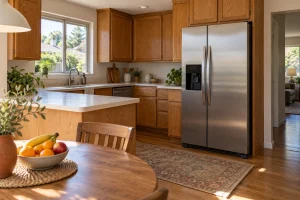
A refrigerator is the one appliance in a San Francisco flat that never gets a day off, so a small change in how it behaves is worth noticing early. Maytag refrigerators turn up in every kind of Bay Area home, from French-door units in remodeled Noe Valley kitchens to side-by-side cabinets squeezed into a galley in an Outer Sunset in-law unit. We diagnose and repair them on site, and this is how the work usually goes.
When the freezer keeps its temperature but the fresh-food side drifts warm, the problem is often airflow rather than refrigeration. Cold air travels from the freezer to the lower compartment through a duct, and a damper or fan that is stuck, iced over or blocked by packed shelves starves it. A technician checks the evaporator fan, the damper and the air path before suspecting anything sealed.
If neither side is cold, we look at the condenser coil, the condenser fan, the start components on the compressor and the temperature controls. Dust and pet hair on a coil behind a toe grille in a closed galley kitchen is a very common cause, and cleaning it is part of the visit. Anything touching the sealed refrigeration circuit stays with the technician.
Heavy frost on the rear panel means the defrost cycle is not completing. The defrost system has a heater, a sensor and a control that decides when to run it, and any one of them can fail quietly while the freezer seems fine for weeks. Our article on freezer frost buildup walks through what the pattern tells you.
Water inside the cabinet normally comes from a frozen or clogged defrost drain. Water outside the cabinet normally comes from the supply line, the inlet valve, the filter housing or the ice maker fill tube. The first job is working out which side of the door the water starts on. See leaking water for the full checklist.
No ice, small hollow cubes, a dispenser that dribbles or a chute frozen shut all trace back to the same few things: supply pressure, a restricted filter, a frozen fill tube or a freezer that runs too warm for the ice mold. Read ice maker not working before you pull the filter out.
A fan blade rubbing frost, a compressor that clicks and stops, or a unit that starts and shuts off repeatedly each have a different explanation. Describing the sound, when it happens and whether the display changes helps us bring the right parts.
The kitchen around the refrigerator matters as much as the refrigerator. Cabinets built tight to the sides and top leave no airflow for the condenser, and a unit pushed flush against the wall can crush its own water line. In older San Francisco buildings the water line often comes from a shutoff valve under the sink, run through the cabinet floor and across the room, and an old fitting there is a frequent source of slow leaks. Garage refrigerators in the avenues and the suburbs face swings between cold nights and warm afternoons that a kitchen never sees.
Maytag refrigerators with a display or indicator light may show a short code. The code pages on this site give only what is documented for each one, and for several of them that is a reset instruction and a recommendation to call for service. Look at Maytag refrigerator flashing F, the H2O light and the PO code. Whatever you see, write it down exactly as it appears and note whether it came back after one power reset.
Please do not remove back panels, pry at the fan cover, chip ice off the evaporator or touch the sealed system. Those steps are where a minor fault becomes a larger one.
Switch the breaker off if you smell burning, hear a loud buzz from the back or see water around the plug. For food that has warmed, use your own judgment about what to keep, and move perishables to another refrigerator or a cooler while the unit waits for repair. A refrigerator that is only a little warm is still worth a prompt visit, because the cause tends to get worse, not better.
Maytag has built French-door, side-by-side, bottom-freezer and top-freezer refrigerators across many generations, and parts such as fan motors, defrost sensors, water valves and control boards are not interchangeable between them. The model label usually sits on the inside wall of the fresh-food compartment or along the door frame. With it in hand, we arrive knowing what to look at and what is likely to be needed. A few of the units we see most often are the Maytag MFI2570FEZ, a 36-inch French-door model, the Maytag MRFF4236RZ, also a 36-inch French-door, and the Maytag MRSF4036PZ, a 36-inch side-by-side.
The Maytag refrigerators guide describes the lineup and where the label is found. For this service, the most useful troubleshooting reading is refrigerator not cooling, refrigerator leaking water and freezer frost buildup. When you are ready, request a Maytag refrigerator repair visit in San Francisco or elsewhere in the Bay Area and tell us what you have noticed.
Warm food with a humming cabinet usually means the cold is being made but not delivered or not kept. A technician looks at the evaporator fan, the defrost system, the condenser coil and the door seal before anything else, because each of those can produce the same symptom with very different repairs.
A small leak from a clogged defrost drain or a loose water line is not an electrical danger by itself, but water under a cabinet can damage hardwood, subfloors and the unit below you in a multi-unit building. Shut the water supply valve, dry the floor, and book a visit. If water has reached an outlet or cord, switch the breaker off first.
Write down exactly what the display shows. One controlled power reset is a reasonable owner check, and the code pages for Flashing F and H2O light give no cause, only reset and service steps. If the indicator returns after the reset, a technician needs to diagnose it.
It helps a great deal. The label tells us which parts and which control layout to prepare, so please photograph it when you request the visit. It is usually on the inside wall of the fresh-food compartment or on the door frame.
No. We diagnose first, give you a written estimate, and repair nothing until you approve it. If you decide not to go ahead, you simply have the diagnosis.
Maytag French-door and side-by-side refrigerators in San Francisco homes: the documented lineup, common complaints, display messages and safe checks before you book.
Maytag electric and gas cooktops repaired in Bay Area homes: dead zones, burners that click without lighting and touch control faults, with…
Drain, fill, heat, latch and control faults on Maytag dishwashers diagnosed in San Francisco and the Bay Area, with a written estimate…
Maytag electric and gas dryers diagnosed on site at your Bay Area home, from clogged vents and no-heat faults to worn belts,…
Over-the-range Maytag microwave repair in San Francisco and the Bay Area, from no-heat faults to vent fans, door latches and display codes.
Share a few details and we’ll confirm an appointment. Prefer to talk? Call us and we’ll help right away.