

Specialized Maytag Appliance Repair in San Francisco
Mon–Sat: 8:00 AM – 7:00 PM
Puddles under a Maytag refrigerator come from a handful of places: the water line, the defrost drain, the ice maker or a cracked tray. Find your pattern and learn what to do next.
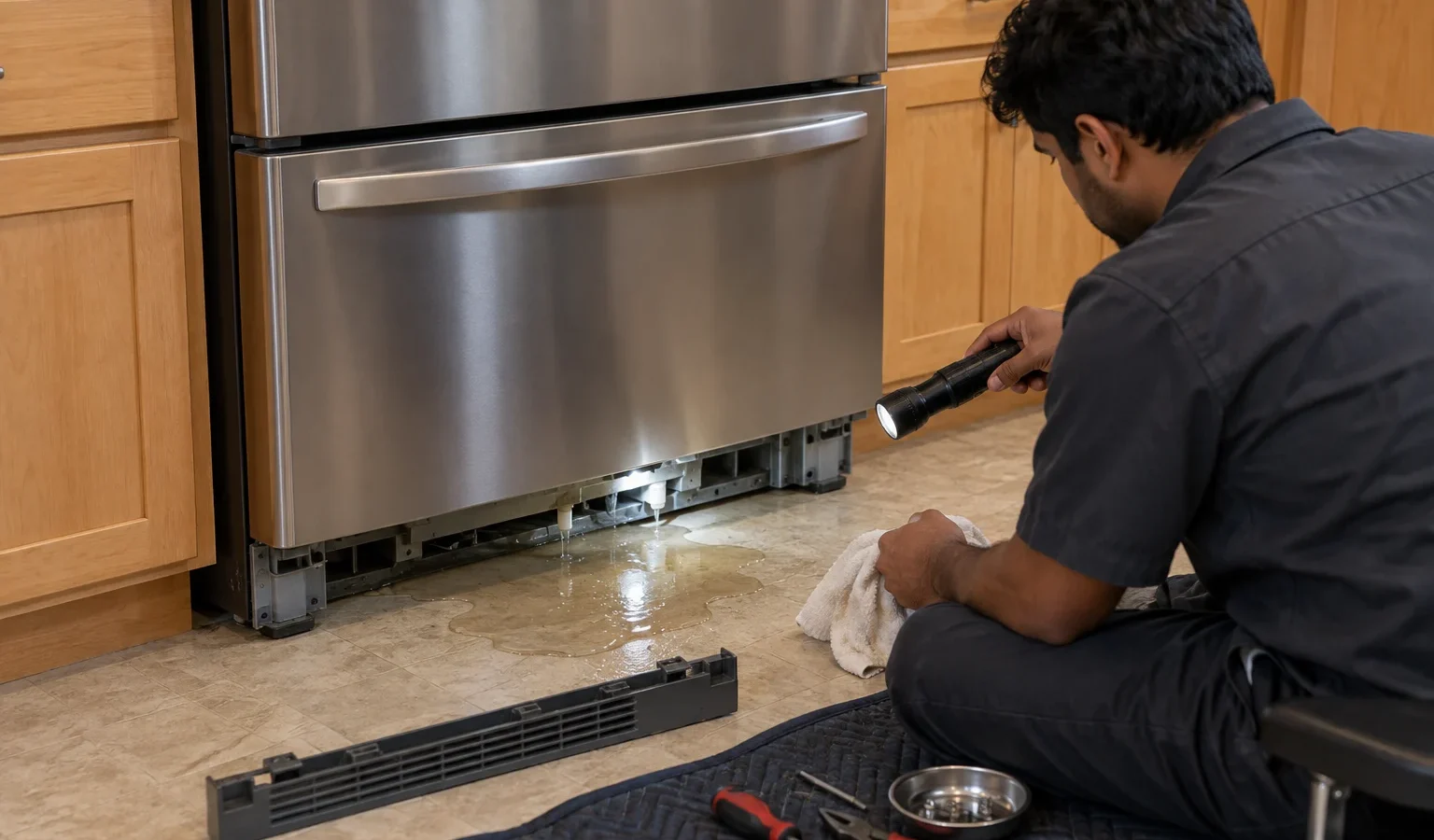
Water under a refrigerator rarely arrives out of nowhere. It is either coming from the supply side, the plumbing that feeds the ice maker and dispenser, or from the drain side, meltwater from the defrost cycle that should flow quietly to a pan. Telling those apart is the quickest route to a fix, and the pattern of the puddle usually does it for you.
Dry the floor and watch. A thin trickle at the front near the crisper drawers, appearing a few hours after a defrost cycle, suggests the defrost drain is blocked. A slow spreading pool toward the back or one side, even when no one touches the dispenser, points to the water line or the inlet valve. Drips below the door of the freezer, or water mixed with ice shavings, tell us the ice maker or its fill tube is the source. Water that appears only after you fill a pitcher at the dispenser leads somewhere else again.
Also look inside. A sheet of ice on the freezer floor, or a slick, frozen patch under the crisper drawers, shows meltwater that is refreezing instead of draining.
Start with the shut-off valve on the water line. If you can reach it, turning it closed will stop a supply-side leak while you sort things out; a quarter turn on a stop valve is all it takes. Look at the visible tubing for kinks and for wet spots at the fittings. If the refrigerator was recently moved, the line may have been pinched against the wall.
Check that the doors close squarely and that the gasket is clean, flat and free of tears. Clear any items blocking the drain opening at the back of the fresh-food compartment, where a small hole usually sits low on the rear wall, and look for visible food residue. Wipe it with a soft cloth, but do not push a wire or a sharp tool into it.
A flashing indicator may point to a related condition. Our page on the H2O light explains how Maytag describes that indicator on units that have one. Make a note of anything that lights up, so you can describe it when you reach us.
Do not tilt the refrigerator onto its back, pull off rear panels, or tighten fittings with a wrench until they squeal; a cracked fitting is worse than a weeping one. Do not use hot water to clear a frozen drain, since it can warp plastic and run into the electronics. Do not ignore water that reaches an electrical outlet or an extension cord. If that happens, switch the power off at the breaker and keep the area dry before anything else.
Standing water also damages flooring. In upper-floor flats and older Victorians split into units, a slow leak can travel through the subfloor to the neighbor below, so stopping the source early protects more than your own kitchen.
Built-in and cabinet-depth refrigerators sit close to the wall, which makes the supply line easy to crush when the unit is pushed back. Flexible lines should have a gentle loop with room to spare. Hard copper lines that were fine for an older fridge sometimes vibrate against the back panel. A unit that no longer sits level can also send meltwater away from the pan, so we check leveling at every visit.
Garage refrigerators in homes across the avenues and the suburbs deal with temperature swings that freeze lines or condense moisture. And in rentals where several appliances were installed at different times, the water line to a French-door model may be a retrofit that was never secured properly.
Leaks show up on every layout, but the likely source changes with the design. A French-door unit with an ice maker in the freezer drawer or door, such as the Maytag MFI2570FEZ, brings a long water path. A side-by-side such as the Maytag MRSF4036PZ often has a dispenser in the door as well. Tell us the label number when you call, and if you need help finding it, see how to find your Maytag model number.
Book a visit when the leak returns after you have cleared and dried everything, when the water is clearly coming from behind the unit, when you find ice where it should not be, or when the supply fitting is the suspect. We diagnose first, explain what we see, put the estimate in writing and wait for your approval before touching a part. Read more on Maytag refrigerator repair, or look over the Maytag refrigerators we service. If the problem involves the cubes themselves, Maytag ice maker not working covers that side.
If the water is small, clear of outlets and not coming from the back, the unit can usually keep running while you arrange service. If water reaches electrical parts, switch off the breaker.
That is where a blocked defrost drain shows itself. Meltwater cannot leave through the drain, so it collects and spreads in the lowest part of the cabinet.
A filter that is seated crooked or an old housing can drip at the connection. If the leak began right after a filter change, reseat it carefully and look again.
Close the stop valve on the supply line, dry the floor, and keep the refrigerator closed. Put a towel or a shallow tray under the front if the drain is the problem.
Standing water can swell laminate and lift the finish over time. Dry it promptly and tell us how long it has been leaking when you book.
Share a few details and we’ll confirm an appointment. Prefer to talk? Call us and we’ll help right away.