

Specialized Maytag Appliance Repair in San Francisco
Mon–Sat: 8:00 AM – 7:00 PM
A Maytag dryer that tumbles without heat may have a tripped breaker leg, a failed heater, a gas ignition fault or a blocked vent. Here is how to sort it out.
The drum turns, the clothes tumble, and an hour later they come out as cold and damp as they went in. A Maytag dryer that runs without heat is a common complaint, and it splits into two very different families: electric dryers that lost their heating element or its power, and gas dryers that lost their flame. A third possibility, a blocked vent, can make either type look as if it has no heat.
An electric dryer plugs into a large outlet and heats with a coil. A gas dryer plugs into a normal outlet to run the drum and burns gas to make heat. The difference decides the diagnosis. If the model number does not make it clear, the label on the door frame or a look at the back of the machine will. A plug with a thick cord means electric; a gas line fitting means gas. Models on our lineup include electric units such as the MED7205RF and gas units such as the MGD7205RF.
An electric dryer needs two legs of household power, not one. If one leg fails, the drum still turns and the lights come on, but the heater gets nothing. A tripped half of a double breaker is a classic cause that looks like a dead heater. Inside the machine the heater coil can burn out, a thermal fuse can open after overheating, and the control or heater relay can stop sending power. Codes may help: F4 E1 is described as a problem with the heater or its relays, and F4E2 is described as a second heater failure on electric models. F4E4 and F4 E4 describe low voltage on the second leg.
A gas dryer needs an igniter that glows, a gas valve that opens and a flame that stays lit. If any one of them fails, the dryer tumbles with no heat. The details are in the article on a Maytag gas dryer not igniting. If you ever smell gas, leave the home, do not touch any switch, and call the gas utility or 911 from outside.
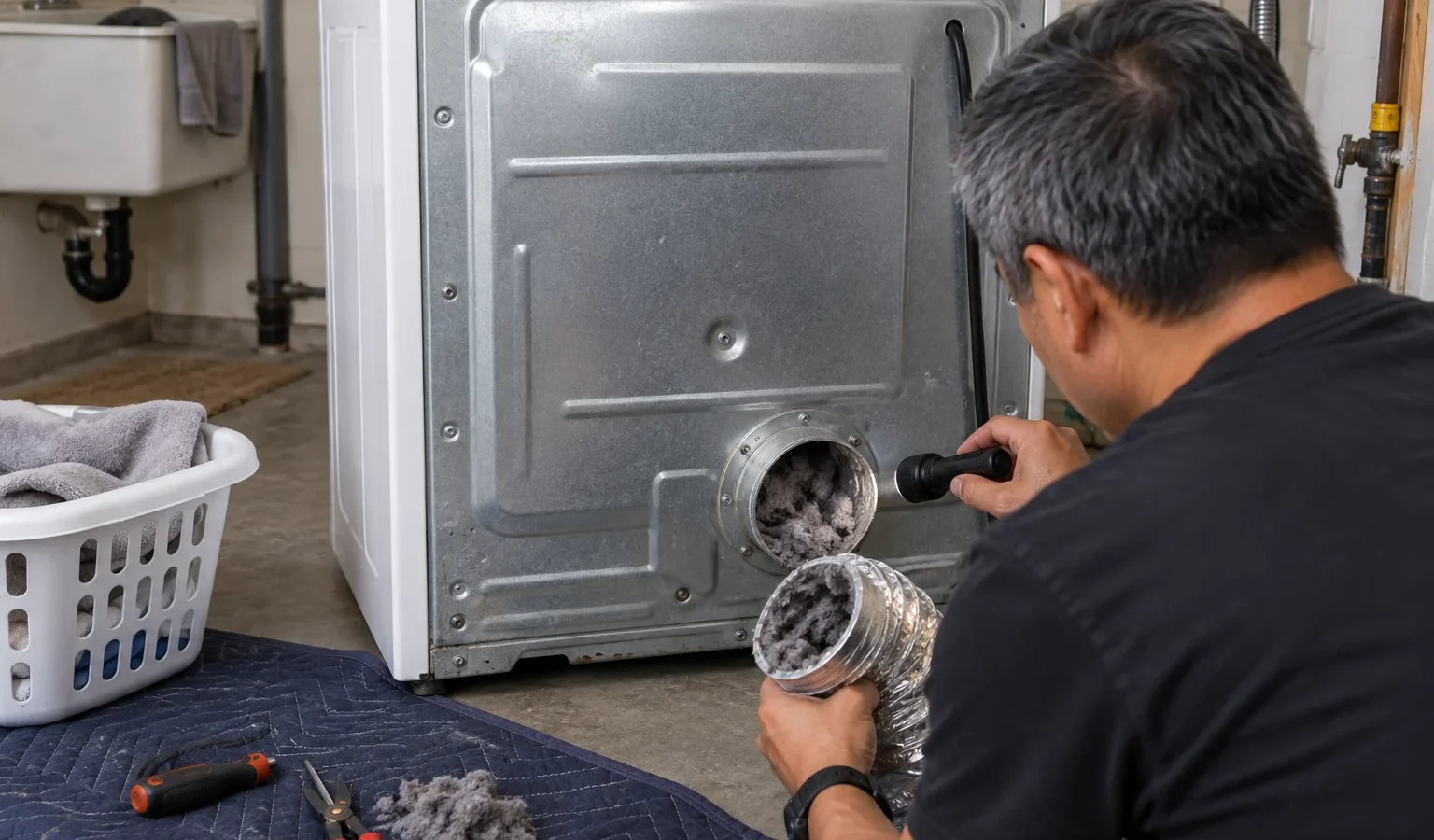
Dryers protect themselves from overheating. When the exhaust is restricted by lint, a crushed duct or a stuck flap on the outside wall, the heater cycles off on a safety limit and the clothes never dry. Maytag describes AF, F30 and F4 E3 as restricted-airflow codes, and F4E5 as a high limit where the temperature threshold was exceeded, usually from poor airflow. This is the most common cause in the Bay Area, where duct runs are long and wind through older walls, up through a roof or out a side yard.
Do not open the dryer cabinet to test the coil or the fuse; there are live parts inside even when the dryer is not running. Do not run a dryer with a restricted vent over and over. Heat that cannot escape builds in the drum and the ductwork, and lint is flammable. Do not use foil or plastic dryer hose, which sags and traps lint. If you smell burning or see smoke, switch off at the breaker and leave the dryer alone.
When you contact us, it helps to describe exactly what happens: no heat at all, heat that comes and goes, heat that works for a short time then fades, or heat that works only on a certain setting. A dryer that heats for a short time and then goes cold often hits a limit, while a dryer that never warms tends to point at the heater circuit or the igniter. A dryer that is taking very long to dry, but does warm up, belongs to a different article: Maytag dryer takes too long.
Closet and stacked laundry in flats usually puts the dryer on a short, tight duct, sometimes with a rear elbow that is squashed against the wall. In older buildings the exhaust may run into a shared chase that has never been cleaned. In garages in the avenues and the suburbs the vent sometimes passes through a cold space where moist air condenses and collects lint. Landlords and managers with several dryers should note that a single lint-packed vent can make one unit seem faulty while its neighbors work.
Book a visit if the breaker is on and the vent is clear and the dryer still does not heat, if it displays a heater or high-limit code, or if a gas dryer does not light. The technician diagnoses before repairing, provides a written estimate and does nothing without your approval. Read how it works on the Maytag dryer repair page and see the electric and gas lineup on the Maytag dryers page. For the whole set of messages, see the Maytag dryer error codes article.
The drum motor and the heating circuit are separate. The heater may have lost power, the coil or flame may have failed, or a safety limit may have shut the heat off because of a blocked vent.
Yes. Electric dryers use a double breaker, and one half can trip while the drum still turns. Switch it fully off and on to test.
Yes. The dryer cuts the heat when airflow is poor. Cleaning the lint screen and checking the outside hood flap is the first step.
We do not recommend it. Internal parts carry live power even when the dryer is not running. A diagnosis first confirms whether the element is the cause.
Some codes apply to electric models only, such as the second heater and second-leg voltage messages. Share the model number so the code is read for your dryer type.
Share a few details and we’ll confirm an appointment. Prefer to talk? Call us and we’ll help right away.