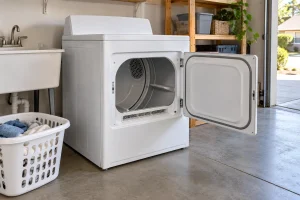
Dryers
Electric and gas Maytag dryers in Bay Area garages and closets: the documented models, usual faults, airflow codes and safe checks before…

Specialized Maytag Appliance Repair in San Francisco
Mon–Sat: 8:00 AM – 7:00 PM
A dryer that runs but does not dry is usually telling you something about airflow or heat. We trace it at your home.
A dryer that stops doing its job rarely fails all at once. Clothes come out damp after a full cycle, the drum runs but the air stays cool, the laundry smells scorched, or the panel flashes a code and quits. Maytag dryers are everywhere in the Bay Area, from the closet stacks in Mission and Richmond flats to the garage pairs in Sunset and Daly City houses and the shared laundry rooms of older apartment buildings. We diagnose and repair electric and gas Maytag dryers at your address.
Poor drying is the complaint we hear most, and it is usually a story about air. A dryer pushes warm air through the drum and out through a duct; if that air has nowhere to go, heat builds up, the safety thermostat trips and the cycle drags on or ends early. In San Francisco the duct is often long and awkward, running up through a wall or along a basement ceiling to a vent hood on a back lightwell. Lint settles in the bends, and a flexible duct squashed behind the machine can close off most of the opening.
We check the airflow at the machine and at the hood, then the blower wheel, the lint housing and the moisture sensor strips inside the drum. Fabric-softener residue on those strips can make a dryer misjudge the load. Only after the air path is clear do we look at the heating parts.
An electric dryer makes heat with a heating element and a set of thermal protectors. A gas dryer makes it with an igniter, a gas valve with coils and a burner. The symptoms overlap, but the repair does not, so the first job is to establish which kind of heat failure it is.
Heat that comes and goes, or cycles that grow longer, usually mean restricted venting is tripping a safety part; see why a Maytag dryer takes too long. Our guide to a Maytag dryer not heating covers the symptom from the owner’s side.
A squeal that rises with the drum is normally a worn drum roller, an idler pulley or a belt on its way out, while a thump with each rotation can be a flat spot on a roller. Our article on Maytag dryer squeaking noise separates the likely sources. A burning smell is different: stop the cycle, switch the dryer off at the breaker and leave it alone until a technician has looked at the lint path, because trapped lint near a heat source is a hazard.
If the drum does not turn at all, a snapped belt, a motor that hums without starting or a door switch that does not register a closed door are the usual suspects.
Maytag dryer displays use letter-and-number codes, and several of them have a known meaning. We list the ones people ask about most so you can write down what you see before you call.
Many of these point to the vent and the supply rather than a failed part. Our overview of Maytag dryer error codes collects the rest.
The same fault can look quite different depending on where the dryer lives. A closet dryer under a stacked washer has almost no clearance, so a vent that has been pushed flat is common and the lint builds fast. A garage dryer sees cold nights and dust, and a long duct run can sag and trap lint in the low spot. A gas dryer needs an accessible shutoff valve and an unkinked connector, while an electric dryer relies on a cord and receptacle that match the circuit. A worn receptacle that heats up is a hazard in itself.
When a landlord has the same dryer in several units, we note the pattern. If every unit on one stack dries slowly, a shared riser or roof vent is a better suspect than any one machine.
If the dryer smells of gas, leave the home, avoid switches and call the gas utility or 911 from outside. If you notice a burning smell or see sparks, switch the dryer off at the breaker. Do not open panels, test live circuits or touch gas fittings yourself.
Parts that look alike across dryer generations are often not interchangeable. Read the model label before we arrive; it is usually on the dryer door opening or the inside edge of the door. Our guide on how to find your Maytag model number shows where to look, and the numbers we see in Bay Area homes include MGD7205RF, a gas Pet Pro top-load dryer, and MED8630HC, an electric Smart front-load dryer.
We ask what the dryer did before it stopped, then inspect the vent and lint path before opening the cabinet. You get a diagnosis first, then a written estimate, and nothing is repaired until you have said yes. For more about the lineup, see our Maytag dryers guide, and for the repair-or-replace decision, read when to repair or replace a Maytag appliance.
Often, but not always. A blocked vent is the first suspect. If the vent is clear and the load is still damp, a failing sensor, a weak element or a loose belt becomes more likely.
You can clean the lint screen and clear the vent hood flap from outside. Pulling the dryer out to clean the duct is worth doing only without straining the gas line or cord; long runs inside walls are better left to us.
Leave the home straight away, avoid switching anything on or off, and call the gas utility or 911 from outside. Do not try to find the leak yourself. Book a repair visit only after the utility has cleared the home.
On an electric model it can be a lost leg of the supply, a failed element or a tripped thermal protector. On a gas model it can be the igniter, the valve coils or the flame sensor. Restricted venting can cause the same symptom by tripping a safety part.
Yes. We service Maytag dryers in flats, condos, rentals and shared laundry rooms, and we coordinate with building managers when the vent or riser is shared.
Electric and gas Maytag dryers in Bay Area garages and closets: the documented models, usual faults, airflow codes and safe checks before…
Maytag electric and gas cooktops repaired in Bay Area homes: dead zones, burners that click without lighting and touch control faults, with…
Drain, fill, heat, latch and control faults on Maytag dishwashers diagnosed in San Francisco and the Bay Area, with a written estimate…
Over-the-range Maytag microwave repair in San Francisco and the Bay Area, from no-heat faults to vent fans, door latches and display codes.
Maytag electric and gas ranges repaired in Bay Area kitchens: cold ovens, burners that will not light, wrong oven temperatures and error…
Share a few details and we’ll confirm an appointment. Prefer to talk? Call us and we’ll help right away.