Cooktops
Maytag electric and gas cooktops in San Francisco: 30-inch and 36-inch models, common burner and element faults, code meanings and safe checks.

Specialized Maytag Appliance Repair in San Francisco
Mon–Sat: 8:00 AM – 7:00 PM
One cold zone or a burner that only clicks can be traced to a single part once the cutout and supply are checked.
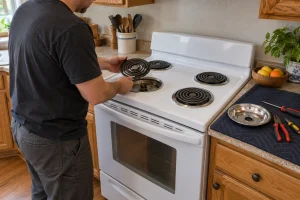
A built-in cooktop sits at the center of the kitchen’s busiest work zone, and when a burner or element quits the whole evening shifts. We repair Maytag electric and gas cooktops in the Bay Area, in condos with stone countertops, remodeled Victorians and family homes alike. A cooktop is a simpler appliance than a range, but its faults are easy to misread, so it pays to know what the symptom suggests before anyone pries up a burner.
On an electric cooktop, each cooking zone has its own heating element, a switch or touch control that sets the power, and a connection to the supply. A cold zone can come from a failed element, a loose or scorched terminal, a worn switch or a control that no longer sends power. When only one zone is affected, the others usually point us to the zone’s own parts; when several zones fail together, the shared supply or the main control is more likely. Our guide to a Maytag cooktop element not heating explains how we tell these apart.
Some Maytag electric cooktops have a reversible grill and griddle section in the lineup. Those added zones add parts that sit under a removable cover, and food spilled into the connections is a surprisingly common cause of a dead section.
A gas cooktop needs a clear burner port, a dry and properly seated cap, and a spark at the right moment. Boil-overs, cleaning liquid and food residue block ports or short the igniter electrode. A flame that is yellow, lazy or lifting away from the port suggests blocked ports or a cap that is out of position rather than a gas problem. When a burner clicks without catching, or lights only after a wait, the igniter or the spark module is the next suspect. If one burner works while its neighbours misbehave, the burner head is usually at fault.
The Power burner on the gas models in our lineup is built to deliver a stronger flame, which means spills near it can be more visible, but the diagnosis follows the same logic: ports, cap, electrode, spark module, valve.
Many electric cooktops use a glass touch panel. Water, a pot sitting on the panel or a film of grease can make the controls behave oddly, and some will beep, lock out or switch themselves off. If cleaning the panel and a single reset do not help, the user interface or the power control board may be at fault. We separate those by looking at how the panel responds and what code it shows.
Several cooktop codes are covered, each with its meaning. Write down exactly what appears on the display.
Hotplate codes name a position, which narrows the search to one zone, while control and board codes tell us the problem sits behind the glass or inside the housing. Either way, the wording is a pointer and we confirm with tests.
A cooktop is dropped into a cutout in the countertop, and its housing needs space below for air and wiring. In condos and remodeled kitchens, a drawer or oven mounted tightly underneath can limit that space, which is why an overheating code means the installation should be checked as well as the unit. A cooktop also depends on a junction connection beneath the counter; if that connection has loosened over time, the symptoms can look like a failed element.
Gas cooktops rely on a shutoff valve in the cabinet below and a flexible connector that must not be pinched by drawers or stored items. After a remodel or a countertop replacement, the connector and the burner levelling both deserve attention. Stone countertops mean we plan carefully to lift the unit without chipping the edge.
If you smell gas, leave the home, avoid switches and call the gas utility or 911 from outside. If you smell burning, see sparks or notice cracked glass, switch the cooktop off at the breaker and stop using it. Do not lift the cooktop out, test live wiring or touch gas fittings.
Elements, switches and boards differ between cooktop sizes, so the model matters. The label is usually found on the underside of the cooktop or on the edge of the housing, and our article on finding your Maytag model number explains the options. Among the cooktops we see are MEC8830HS, an electric cooktop with a reversible grill and griddle, and MGC7536DS, a gas cooktop with a Power burner.
We look at the supply and the control first, then the zone that is acting up. You receive a diagnosis and a written estimate, and the work only goes ahead once you approve it. If the problem turns out to belong to a separate oven or a range, we point you to Maytag range repair. You can also read the Maytag cooktops overview before you book.
The zone’s own element, switch or connection is the likely place to look. When the other zones work normally, the shared supply is probably fine.
Usually, yes, if there is no gas smell, burning smell or sparking. If the cooktop shows an overheating code, wait for it to cool and have the installation checked.
Yes. Spills can block gas ports, foul igniters and creep into the connections under an electric zone. Cleaning a cold cooktop regularly prevents many service calls.
Switch the cooktop off at the breaker and stop using it. Cracked glass can let liquid reach live parts, and the unit needs a technician before it is used again.
Yes. We plan the lift carefully and protect the edges, and we reseat the unit in its cutout afterwards.
Maytag electric and gas cooktops in San Francisco: 30-inch and 36-inch models, common burner and element faults, code meanings and safe checks.
Drain, fill, heat, latch and control faults on Maytag dishwashers diagnosed in San Francisco and the Bay Area, with a written estimate…
Maytag electric and gas dryers diagnosed on site at your Bay Area home, from clogged vents and no-heat faults to worn belts,…
Over-the-range Maytag microwave repair in San Francisco and the Bay Area, from no-heat faults to vent fans, door latches and display codes.
Maytag electric and gas ranges repaired in Bay Area kitchens: cold ovens, burners that will not light, wrong oven temperatures and error…
Share a few details and we’ll confirm an appointment. Prefer to talk? Call us and we’ll help right away.