Dishwashers
Four 24-inch Maytag dishwashers, front and top control, with common complaints, F-codes and the installation points that decide whether a repair is…

Specialized Maytag Appliance Repair in San Francisco
Mon–Sat: 8:00 AM – 7:00 PM
Standing water, a silent Start button or a blinking code: we trace the fault through the drain, fill and control paths and tell you before repairing.
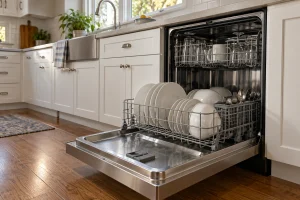
Most Maytag dishwashers in Bay Area homes are built in under a countertop, tucked between a sink cabinet and a stove, with water, drain and power all hidden behind a kick plate. That arrangement makes small faults feel mysterious: a pool of water in the tub, a cycle that never starts, or dishes that come out cloudy. Our job is to trace which part of the hidden path has failed, and to tell you plainly before we touch anything.
Water left after a cycle is the most frequent call. The cause may be a clogged filter and sump, a pinched drain hose behind the unit, a disposer knockout plug that was never removed at installation, an air gap that is full of debris, or a drain pump that has stopped. Our troubleshooting article on a dishwasher not draining covers the order to check.
A dishwasher that is silent when you press Start may have an open door latch, a locked control, a tripped breaker or a failed control board. A door that does not seem to close fully, a light that blinks and then nothing, or a cycle that stalls after a few seconds all have different answers. See a dishwasher that will not start.
Weak cleaning is often a mechanical or supply issue rather than a bad detergent. Spray arms clogged with seeds or bits of label, a filter packed with sludge, an inlet valve that is not letting enough water in, or a heating element that does not heat can each leave a film. Read a dishwasher not cleaning for how to separate them.
Flashing indicators are the control reporting a fault it has detected. The pattern matters: a count of flashes, a letter and number, or a fixed light each point somewhere different. Our guide to dishwasher lights flashing explains how to read what you see.
Water at the front edge can come from a door gasket, a tub crack, a leaking inlet valve or a loose hose clamp. Grinding or humming during the wash can come from a failing motor, a foreign object in the pump or a loose spray arm. Do not keep running a leaking dishwasher over a wooden floor.
Maytag dishwashers show codes in two writing styles, with and without a space, for example F9E1 and F9 E1. The meanings below come from the code pages on this site.
Other codes exist, including control, thermistor, wash motor and diverter faults, and each has its own error code page. Write down the code exactly as shown.
A dishwasher drains through a hose that has to rise high under the counter before it falls into the disposer inlet or a trap connection. Some installations use an air gap on the sink instead. If the loop sags, the hose is kinked or the disposer was swapped and the knockout plug was never knocked out, drain water has nowhere to go. We look at all of that, along with the supply line and shutoff valve under the sink, the electrical connection behind the kick plate and the level of the cabinet. In older Victorian flats and converted units, a long hose run to a distant sink or a shared drain line adds another place for a restriction to hide.
Do not pull the unit out, take off the lower panel or test connections with the power on.
Turn the breaker off and shut the supply valve if you see water spreading, smell burning plastic or hear a sharp electrical buzz. A dishwasher that keeps its door open without latching, or that shows water at the base after every cycle, should be left off until it is looked at.
Dishwashers differ in control style, filter design, rack layout and heating arrangement, so parts are not shared freely between models. The label is usually on the door frame or inside the tub edge, and a photograph of it is enough. Among the current 24-inch units, the Maytag MDB4949SKZ has front controls, the Maytag MDB7959SKZ has top controls, and the Maytag MDB8959SKZ and Maytag MDB9959SKZ add a third rack.
We start with your description and the code, then confirm the drain, fill, circulation, heat and control paths in the order that fits the fault. You receive a written estimate and nothing is repaired until you approve it. The Maytag dishwashers guide gives more on the lineup, and you can request a Maytag dishwasher repair visit anywhere in San Francisco or the Bay Area.
Standing water means the drain path is restricted or the pump is not clearing it. A technician checks the filter and sump, the drain hose, the high drain loop or air gap, and the disposer connection before replacing a pump. A food-clogged filter is the simplest cause and the one you can look at yourself.
It is better to stop. Write down the code, then try one controlled power reset. If the same code returns, the control is telling us something specific, such as a drain, fill, heat or latch fault, and running more cycles can leave water or wet dishes sitting in the tub.
Not necessarily. Grit usually points to a clogged filter, a blocked spray arm hole, a rack loaded against the arm or a fill problem. If those are clear and the cycle still ends dirty, we diagnose the wash motor, the circulation path and the heat.
Yes. Most of our visits involve a dishwasher recessed under a counter, and we plan for limited access, a sink above and a drain hose that runs into the disposer or a wall connection.
You get a written estimate that lists each fault and its repair, and you decide which to approve. We do not repair anything without your approval.
Four 24-inch Maytag dishwashers, front and top control, with common complaints, F-codes and the installation points that decide whether a repair is…
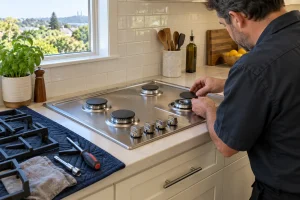
Maytag electric and gas cooktops repaired in Bay Area homes: dead zones, burners that click without lighting and touch control faults, with…
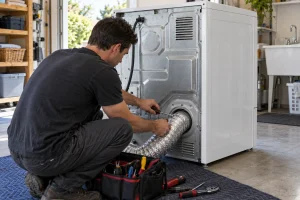
Maytag electric and gas dryers diagnosed on site at your Bay Area home, from clogged vents and no-heat faults to worn belts,…
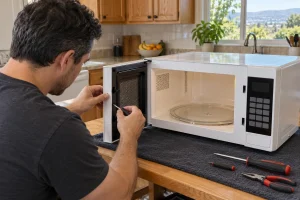
Over-the-range Maytag microwave repair in San Francisco and the Bay Area, from no-heat faults to vent fans, door latches and display codes.
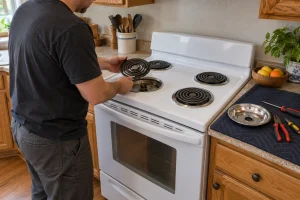
Maytag electric and gas ranges repaired in Bay Area kitchens: cold ovens, burners that will not light, wrong oven temperatures and error…
Share a few details and we’ll confirm an appointment. Prefer to talk? Call us and we’ll help right away.