Microwaves
Over-the-range Maytag microwaves in San Francisco: the models we service, heating and fan faults, code meanings and safe owner checks.

Specialized Maytag Appliance Repair in San Francisco
Mon–Sat: 8:00 AM – 7:00 PM
Over-the-range Maytag microwaves diagnosed on site, with a written estimate and your approval before any repair.
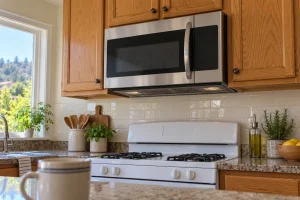
A microwave above the range does two jobs at once: it cooks, and it clears the cooktop of steam and smoke. In a narrow San Francisco galley kitchen, or a condo kitchen with the range pushed into a corner, that hanging unit is often the only ventilation the cook has. We diagnose and repair Maytag over-the-range microwaves, and this is what a typical service involves.
The fan runs, the turntable turns, the clock counts down, and the food stays cold. The heating path in a microwave is separate from the lamp, fan and display circuits, which is why the unit can look healthy and still not cook. A technician checks the door switches, the high-voltage components and the control that commands them, and does so with the unit unplugged and discharged. This is not a task for the household. The article on a microwave that is not heating goes through the pattern in plain language.
Keys that do nothing, a display with missing segments, or a panel that beeps without starting often point to the touch panel, its ribbon connection or the control behind it. Steam and grease from the range below can work into the panel over time, and the vent grille on the bottom of the unit can also trap moisture.
If the door will not latch, hangs crooked or springs open, the cause may be a worn latch hook, a bent hinge or a switch that no longer sees a closed door. A microwave is designed to refuse to run with the door open, so a microwave that stops mid-cycle may be telling you the door is not seated. Do not use a unit with a damaged door or seal.
The vent fan is a motor, and it can squeal, slow down or quit. The lamp over the cooktop may fail while the unit still cooks. Some models include a sensor that turns the fan on when steam rises, so a fan that starts at the wrong time can trace back to that sensor.
A humming that grows louder, a grinding turntable, sparks inside the cavity or a burning odor each have different causes. Food splatter, a damaged waveguide cover or a metal object can spark. A burning smell with sparks is a reason to cut power right away.
Over-the-range Maytag models display short codes, and we explain only the meanings we can confirm. E03 means the keypad reported a problem to the control board. E11 points to the gas sensor. E21 and E22 describe the thermal sensor circuit as open or shorted. F2H1 concerns the vent fan and light switch on the lower left front side panel, while F3H involves the humidity thermistor. A code such as FC E1 is a Wi-Fi problem on a connected model, which has no bearing on cooking. Write the code down exactly and compare it with the error code pages before you do anything else.
An over-the-range unit hangs from a mounting plate on the wall and from bolts through the cabinet above. The weight sits on those fasteners, so a unit that has loosened or sagged can strain the door alignment and the wiring. The way the unit vents matters too. Some kitchens duct the exhaust outside through the wall or roof, and others recirculate through a filter and back into the room. In a flat where the ductwork runs through an old wall, a crushed or blocked duct leaves grease and steam in the cavity and can make the fan or thermal sensor report faults.
Clearance above a gas range is another point. The unit sits over burners, so heat and grease collect on its underside and on the grease filters. Cooktops that are very wide, or pots that are very tall, push heat toward the bottom panel. Many older Bay Area kitchens have a short run of cabinet and a shared circuit, and a microwave plugged into a crowded outlet circuit can trip a breaker whenever the range hood or a nearby appliance draws power as well. Removing a heavy unit from the wall takes two people and care, so it belongs to the technician.
Confirm the plug is seated and the outlet or breaker has power. Close the door firmly and look for food caught in the latch area or the gasket. Remove and wash the grease filters under the unit, then clear the vent grille of lint and grease. Write down the code and any pattern, such as whether the fault appears only after the range has been on. One controlled power reset, by unplugging the unit for a short while and plugging it back in, is acceptable.
Do not remove the outer cover. The inside of a microwave can hold a dangerous charge even when the unit is unplugged, so no household check involves opening the case. Do not run the unit empty, and do not bypass the door switches.
Unplug the microwave or switch off its breaker if you see sparks, smell burning plastic, notice a bulging or damaged door, or find the cavity floor scorched. Do not use a microwave whose door will not close properly. If the unit hangs unevenly from the wall, stop using it and keep the cooktop below clear until it has been checked.
Over-the-range models differ in sensors, controls and cooking features, and parts that look alike do not always fit. The model label usually sits inside the door frame or on the side wall of the cavity. Our guide on finding your Maytag model number shows the typical spots. The over-the-range models include the MMV1175JZ at 1.7 cu ft, the MMV4207JZ with Dual Crisp and the MMV6190FZ convection model, both 1.9 cu ft.
You describe the symptom and give the model number and any code. The technician examines the unit on site, tests to confirm the fault, and explains it. You receive a written estimate, and no work begins without your approval. Property managers with many identical units in a building can group visits. If you want to compare the unit with your options, read when to repair or replace a Maytag appliance, and browse the Maytag microwaves guide for the lineup.
The fan, turntable and display use different circuits than the part that makes heat. A technician tests the door switches and the heating components in the right order, so the unit can be fixed without guessing at parts.
No. The inside of a microwave holds a charge even when it is unplugged. Owner checks are limited to the plug, the breaker, the door seal, the grease filters and the vent grille.
It points to a circuit or part that reported a fault, such as a sensor, the keypad or the control. Our code pages explain the confirmed meaning for each code, and the technician confirms it by testing.
Yes. We service over-the-range Maytag microwaves in place. Because the unit hangs over the burners, grease on the filters and the underside is a common factor, so we look at the venting path as well.
Clear the area under the microwave, keep the cooktop cool, and have the model number, the symptom and any code written down. If the unit is loose on the wall, tell us when you book.
Over-the-range Maytag microwaves in San Francisco: the models we service, heating and fan faults, code meanings and safe owner checks.
Maytag electric and gas cooktops repaired in Bay Area homes: dead zones, burners that click without lighting and touch control faults, with…
Drain, fill, heat, latch and control faults on Maytag dishwashers diagnosed in San Francisco and the Bay Area, with a written estimate…
Maytag electric and gas dryers diagnosed on site at your Bay Area home, from clogged vents and no-heat faults to worn belts,…
Maytag electric and gas ranges repaired in Bay Area kitchens: cold ovens, burners that will not light, wrong oven temperatures and error…
Share a few details and we’ll confirm an appointment. Prefer to talk? Call us and we’ll help right away.