

Specialized Maytag Appliance Repair in San Francisco
Mon–Sat: 8:00 AM – 7:00 PM
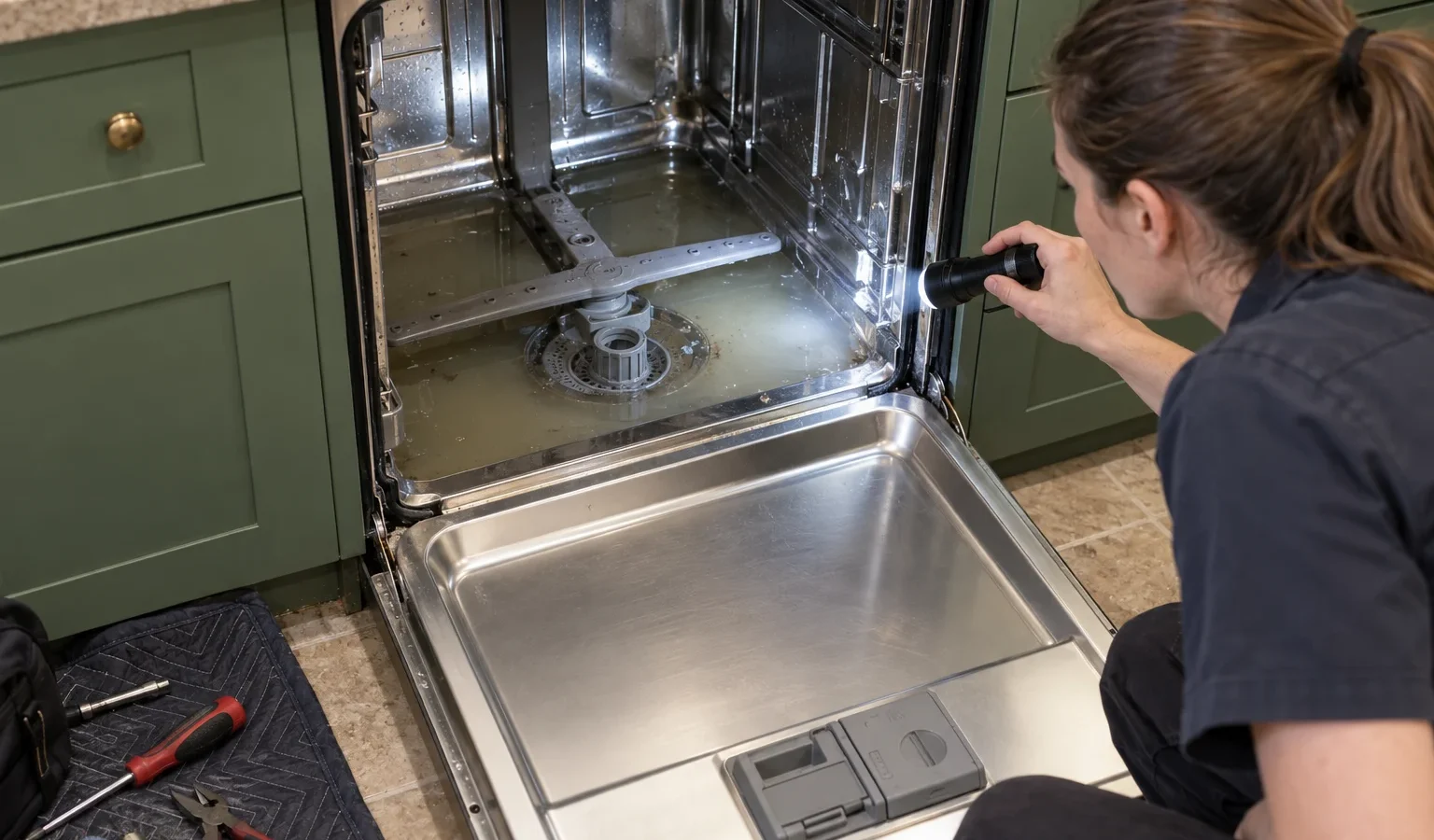
Dirty water left at the bottom of a Maytag dishwasher usually comes from a clogged filter, a kinked hose, a disposer plug or a failed drain pump. Here is the order to check.
You open the door after a cycle and find a shallow lake of gray water, with a film of food bits on the bottom. That means the water went in, did its work, and could not leave. The drain path of a dishwasher runs from the sump through a pump, into a hose, past a loop or air gap, and into the sink drain or disposer. Any point on that path can stop the flow, and most of them are easier to reach than people expect.
The most frequent cause is simply debris. Seeds, glass shards, bits of label, a toothpick or a piece of fruit stone can sit in the filter area at the bottom of the tub and keep the pump from moving water. Pull the lower rack out and look at the filter assembly. Many Maytag dishwashers let you twist and lift it out for rinsing under the tap. Remove standing water with a cup or a sponge first, wear gloves in case of broken glass, and clean the screen and the sump area visible beneath it.
If the control reports a clogged filter on the display, Maytag lists it as F7E4 for the filter condition. Do not treat a code as a diagnosis, but write it down for the technician.
Run the sink first. Turn on the faucet and see how quickly it empties, and run the disposer clear if you have one. Then look at the hose. With the power off, pull the dishwasher forward only if you can do it without stretching the water line, or look from the sink cabinet side and check where the hose runs. A drain hose should rise in a smooth loop before dropping to the disposer or standpipe, and any sharp fold is a problem.
Clean the filter, as above. Then run a short cycle with only a small amount of detergent, and see whether it drains. A single controlled reset by turning power off at the breaker for a few minutes can clear a stuck state, but if the water level does not move, stop there.
Check the airgap cap if your sink has one: lift it off and clear the visible chamber. Do not pour drain chemicals into the tub; they sit in a blocked sump, damage seals and are hazardous if you later have to work by hand.
Do not remove lower panels or the toe kick to reach the pump with the power on. Do not reach into the sump with bare hands, since broken glass sits there more often than people think. Do not run the dishwasher repeatedly with water already standing, which can overflow into the base. And if you smell something hot or see scorching on the wall of the cabinet, switch off the breaker.
San Francisco kitchens are often compact, with a dishwasher installed beside a range and a disposer under a small sink. In those spaces the drain hose has little room, and a unit pushed back after a countertop job often kinks it. In rentals the loop may have been left hanging low, so water siphons back. In older buildings the sink drain line is shared with the unit above or below, and a blockage in the stack can give the same symptom. We check the loop, the air gap, the disposer port and the connection to the sink drain before opening the pump.
Maytag dishwashers share a general layout but not the same filter design or pump arrangement. The label is typically on the door edge or inside the tub rim. The article How to find your Maytag model number shows where to look. A 24-inch unit such as the Maytag MDB4949SKZ with front controls and a top-control one like the Maytag MDB7959SKZ may need different parts, so we ask before ordering anything.
If standing water returns after cleaning the filter, the sink drains fine, and the hose is clear, it is time for a diagnosis. We confirm where the flow stops, tell you what we find, put the estimate in writing and wait for your approval before repair. See Maytag dishwasher repair or the Maytag dishwashers page for the lineup. If the dishwasher fills and drains but leaves dishes gritty, Maytag dishwasher not cleaning may fit better.
The shared drain or the disposer is blocked, so water backs up through the connection. Clear the sink drain first.
A small amount in the sump area can be normal. A visible pool over the filter is not.
Running it empty can clear the port, but do not run the dishwasher while the disposer is jammed or blocked.
No. Some models display a code and others only stop with water in the tub, so the lack of a code does not mean the drain is fine.
Yes, it can smell and grow bacteria. Remove it by hand and clean the tub while you wait for service.
Share a few details and we’ll confirm an appointment. Prefer to talk? Call us and we’ll help right away.