

Specialized Maytag Appliance Repair in San Francisco
Mon–Sat: 8:00 AM – 7:00 PM
A Maytag dishwasher that does nothing when you press Start may be missing power, a closed door signal or a response from its control. Work through the checks in a sensible order.
You load the racks, close the door, press Start, and nothing happens. No water, no click, no hum, or perhaps a hum with no cycle. A dishwasher needs three things to begin: power reaching the control, a signal that the door is closed and latched, and a control that agrees to start. When it fails to begin, one of those three is missing, and a few observations will say which.
Listen carefully. Total silence and a dark display point to power. Lights on but no response to the buttons suggest the control or the keypad. A click when you close the door followed by nothing could mean the latch is engaging but the control is not accepting the signal. A hum without water movement hints that the motor or pump is trying but cannot turn, perhaps from a jam. A fill noise followed by a stop points back to the water side rather than the start circuit.
Begin with power. Check the breaker panel and reset any tripped switch. If the dishwasher plugs into an outlet under the sink, make sure the cord is secure, and check whether the disposer switch affects the outlet. Then look at the display; if it stays dark after the breaker is confirmed, that suggests the issue is behind the control rather than in your house wiring.
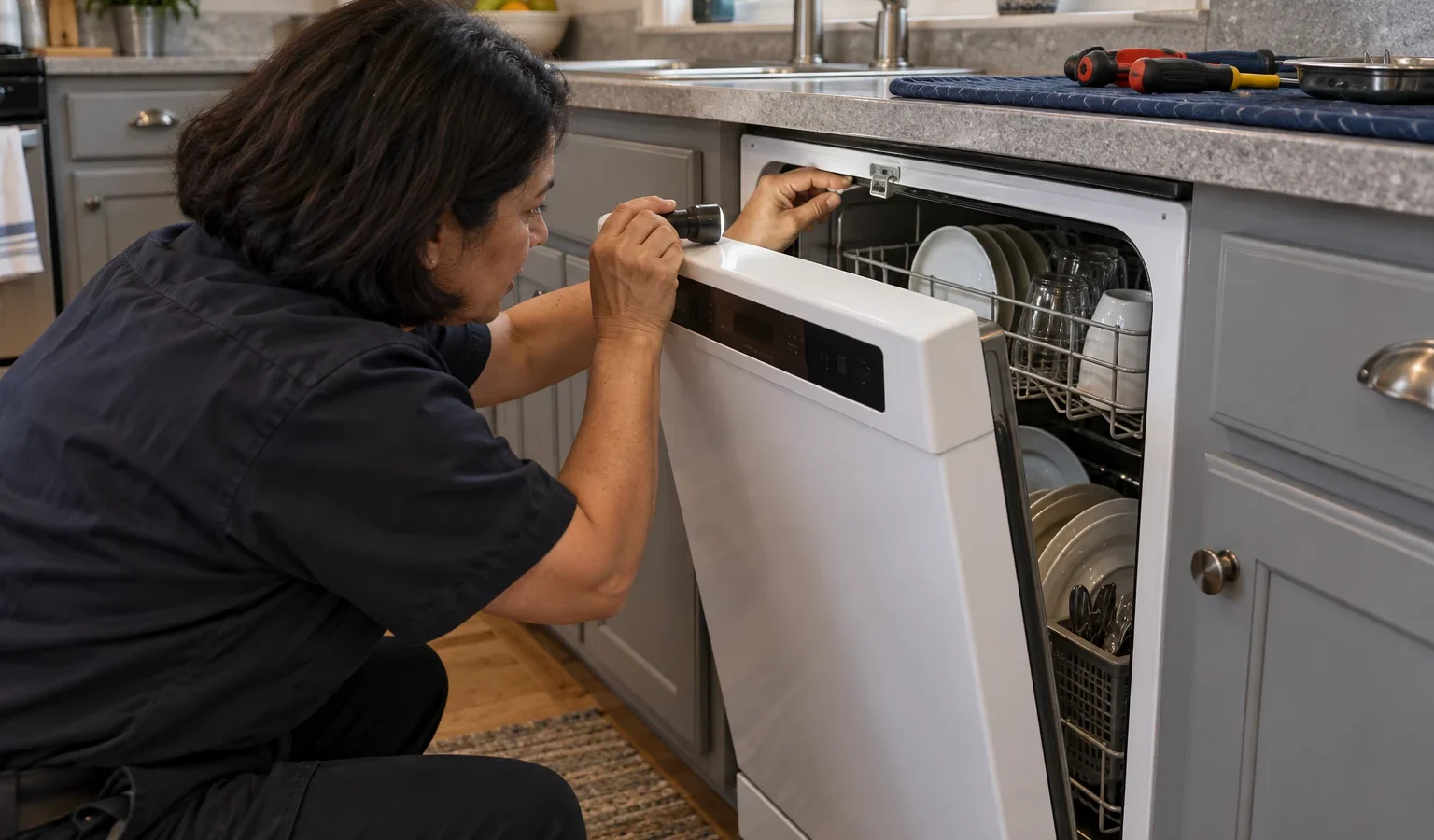
Next, the door. Open it fully and look at the latch area and the door edge. Remove anything resting on the rack that can catch on the door, close it firmly and listen for the latch click. Try again, because some units need a second, firmer push to engage the switch.
Look for the lock setting. Many controls lock when a button is held for several seconds, and a light or symbol shows it. Hold the control-lock button for a few seconds and then press Start again. If a keypad has been wet, dry it and wait for it to recover.
Finally, one reset. Turn power off at the breaker for a few minutes, restore it, and press Start. Some controls lose their place after a power surge, and a reset lets them start from scratch. If nothing changes, the problem is beyond what you can fix from the outside.
With the power confirmed and the door ruled out, the visit moves to the control: does it receive line power, does it recognize the latch switch, and does it send power on to the motor and the fill valve? Each answer splits the search in two. A control that is alive but silent leads to the interface and its ribbon connection, while one that is dead leads back to the supply wiring. That order keeps us from replacing a board when a loose connector was the whole story.
Do not bypass the door switch or tape the latch closed. Do not open the lower panel and test wires while the dishwasher is powered. Do not keep pressing buttons for several minutes, since repeated presses can put a faulty keypad into a worse state. If you smell burning, turn off the breaker and stop.
A dishwasher that stops working after a kitchen update often has a loosened electrical connection or a pinched wire from where it was slid back into the cabinet. In flats with older wiring, shared circuits and sticky GFCI protection are frequent. A disposer replacement may have rerouted power to the dishwasher, or its wall switch may now control the dishwasher outlet by accident. Under-sink moisture can corrode a connector and leave the control without power. We check the electrical connection, the door and latch alignment, and the cabinet for signs of water before we open the control.
Controls and latches differ between Maytag dishwashers. The model number, on the tub rim or door edge, helps us bring the right parts; see how to find your Maytag model number. A front-control unit like the Maytag MDB4949SKZ and a top-control one like the Maytag MDB7959SKZ have different control access and interface parts.
If power is confirmed, the door latches, no lock is on and a reset does nothing, book a diagnosis. We test the latch, the control and the motor, explain the cause, and give you a written estimate. We do not repair anything until you approve. Start at Maytag dishwasher repair and see the Maytag dishwashers we handle. If lights are blinking instead, read Maytag dishwasher lights flashing.
The motor may be trying to turn and failing from a jam or a worn part. Turn off the power and call for diagnosis rather than letting it hum.
Yes, in some kitchens it controls the outlet that powers the dishwasher. Check that switch first.
Not usually. But the door must latch, power must reach the control, and any lock setting must be off.
One reset is reasonable. If the problem returns, repeated resets only delay finding the cause.
Yes. A control that senses a button held down may refuse to start, and moisture is a common trigger.
Share a few details and we’ll confirm an appointment. Prefer to talk? Call us and we’ll help right away.