

Specialized Maytag Appliance Repair in San Francisco
Mon–Sat: 8:00 AM – 7:00 PM
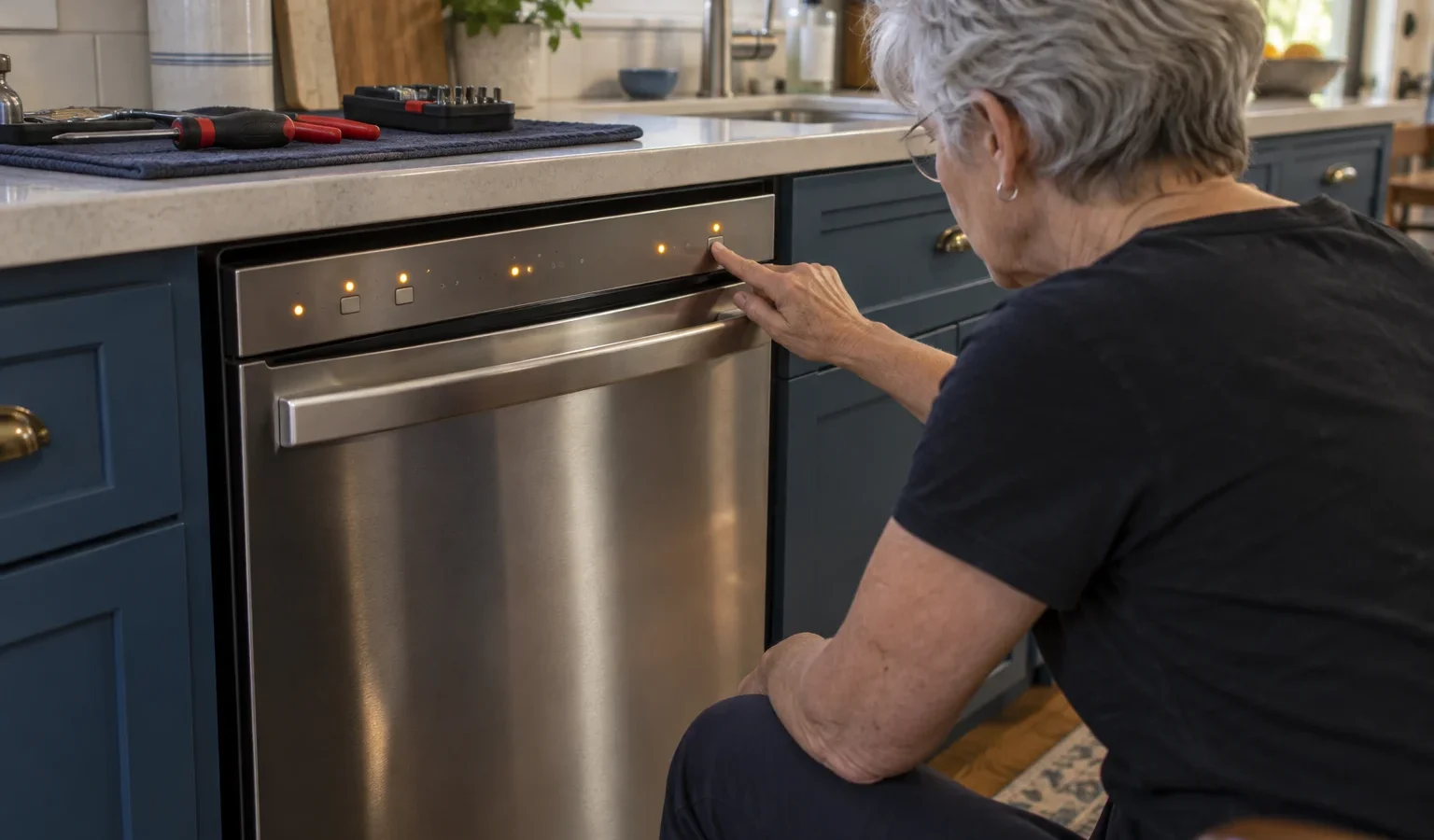
Blinking indicator lights on a Maytag dishwasher are the control's way of reporting a fault. Learn how to write down the pattern, what the listed codes mean and what is safe to try.
A dishwasher that flashes its lights instead of running is trying to tell you something. Some Maytag models show a letter and number pair on a display, while others blink the cycle lights in a pattern you have to count. In both cases the control has found a fault, stopped the cycle to protect itself, and is waiting for you to respond. Before touching anything, you want to capture the message accurately.
Close the door, press Cancel or Start once so the display wakes up, and watch. Does the display show an F followed by a number, then an E and another number? Do the lights flash together or in sequence? Does the pattern repeat after a pause? Write it down, or take a short video on your phone. The difference between F8 E1 and F8 E2 is the difference between a closed tap and an electrical fault, so accuracy matters.
Maytag’s notes list codes in a few forms, and the spacing varies (for example F8 E1 and F8E1 can appear for the same family of problems). That is why the pages below list them as they were recorded. They describe what the control reports, not which part has failed.
These are meanings we can pass on, taken from the recorded entries for Maytag dishwashers:
Other entries exist for the spaced versions of these, such as F9 E1 for a long drain and FAE4 for a diverter valve error. If your code is not here, the full list lives in our error codes section.
An F8E1 can mean the shut-off valve is closed, but it can also mean a clogged inlet screen or a failed valve that cannot open. An F4E2 might be a loose connector rather than a burned element. A stuck-key message can come from moisture around the control rather than a defective panel. This is why the technician confirms with tests before replacing anything, and why we do not suggest buying a board because the display flashed.
Match the safe check to the signal. For anything that sounds like water, confirm the supply valve under the sink is open and the hose is not kinked. For a door message, open the door, look for a fork or dish handle in the latch, and close it firmly until it clicks. For a drain message, clean the filter at the bottom of the tub and check the sink drain. For a keypad message, dry the panel, wipe it with a lightly damp cloth and keep your hands off the buttons.
After that, do one controlled reset: switch the dishwasher off at the breaker or unplug it where accessible, wait a few minutes, restore power and run a short cycle. If the same pattern comes back, the fault is real and repeatable, which is exactly what a technician wants to hear.
Do not pull the control panel apart, do not jump door switches, and do not run repeated resets hoping the message will disappear. A code that vanishes and returns is a fault that is intermittent, and repeated restarts can leave you with a half-washed load and standing water. If the display shows a heater or motor message and you smell hot plastic, cut the breaker.
Controls save a fault and show it again on the next start attempt, which is why a message can appear to follow the machine around. If it shows up only on the first cycle after a long idle period, moisture, a cold kitchen or a low supply may be involved; if it appears halfway through, the fault is more likely tied to a part that heats up, like a motor or a heater. Telling us when in the cycle the lights start blinking narrows the search before we arrive.
Many flashing-light calls from flats and condos trace back to the installation, not the machine. A supply valve closed during a sink repair, a drain hose crushed behind the unit or a loose electrical connection after a counter replacement can all trigger a code. In rentals, the dishwasher may have been disconnected for painting and reconnected incompletely. We check the supply, the drain, the connection and the level before testing components.
Code meanings can differ between control generations, so the model matters. The label is typically on the door edge or the tub rim; see how to find your Maytag model number. A top-control 24-inch unit like the Maytag MDB9959SKZ may show different information from a front-control one such as the Maytag MDB4949SKZ.
If the same message returns after the safe checks, schedule a diagnosis. We find the cause, put the estimate in writing, and begin repairs only after you approve. Start at Maytag dishwasher repair or browse Maytag dishwashers.
Not always. Some patterns indicate a door that is not latched or a water supply that is off, both of which you can correct.
You can try one reset. If the fault returns, the machine is telling you the problem is real.
Some models blink the cycle lights instead of showing letters. Count the pattern and record it for the technician.
Usually not, but if you smell burning or see smoke, turn off the breaker immediately.
Write it down exactly and share it with us. We will look it up against your model number during diagnosis.
Share a few details and we’ll confirm an appointment. Prefer to talk? Call us and we’ll help right away.