

Specialized Maytag Appliance Repair in San Francisco
Mon–Sat: 8:00 AM – 7:00 PM
A flashing lid lock light or an LdL, dLO or dU code means the washer cannot confirm its lid is secured or free. See what Maytag says each one means and what you can check.
Top-load washers do not spin until the lid is down and locked, and they will not let you open the lid while the basket is moving. The mechanism that handles this is the lid lock, a small latch with a switch that confirms the position to the control. When it flashes at you, the washer either could not lock the lid when it wanted to, or could not release it when the cycle ended. Both situations are annoying and rarely dangerous.
If the washer will not lock, you will see something like LdL or dLO. Maytag describes both as the lid lock not locking or a lid lock failure. If the washer will not unlock, the entries are LdU and dU, which Maytag describes as the washer detecting objects on the lid that keep it from unlocking. A related entry, F5E2, is recorded as a lid lock fault where the lock has not moved into the locked position or the motor cannot be powered.
There is also a plain Lid message, which Maytag lists for a lid that was left open. That one is an operator matter rather than a failure.
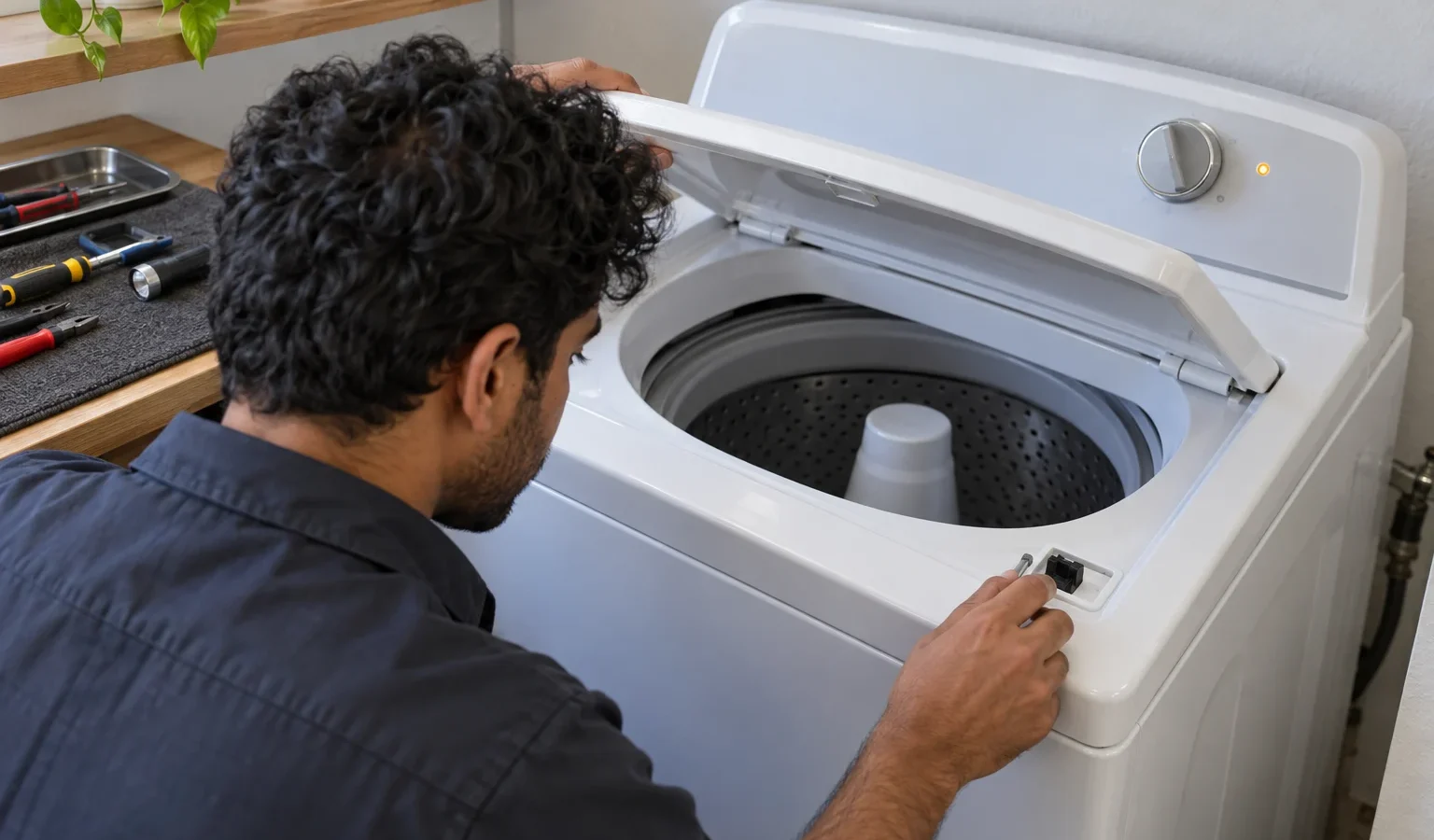
Take everything off the lid. Wipe the lid and the area around the lock with a dry cloth, then a lightly damp one, and let it dry. Open the lid fully, look at the plastic tab on its underside and the slot it goes into. Feel for rough edges or visible damage, and see whether lint is packed into the slot. Gently clear it with a dry soft brush or a wooden pick, without forcing anything into the opening.
Close the lid firmly and watch the light. Some units lock with an audible click when a cycle starts, and a click that comes and goes is useful information. Press Pause or Cancel, wait for the cycle to stop and the basket to come to rest, and try to open the lid. If the lid will not open after the cycle is truly over and the tub is empty, wait a short while, because some models keep the lock engaged briefly after the spin ends.
Then try a single power reset. Unplug the washer for a few minutes, restore power and run Drain and Spin. If the flashing returns the moment the lid closes, the lock itself is the suspect.
Never force the lid open with a tool while the basket is turning, never tape the switch or jam it with a magnet, and never put your hand in a basket that might be moving. Do not bend the strike tab to make it fit, since a bent tab is a broken part waiting to happen. If you must retrieve laundry from a locked washer, unplug it, wait for everything to stop and then ask for service rather than prying the lock.
Lid problems pile up in busy laundries. A shared laundry room in a multi-unit building sees constant use, and lids get dropped, leaned on and loaded with baskets. In garages near the coast, damp air corrodes the lock contacts. In a closet laundry, the washer may sit so close to a shelf that the lid does not open or close fully. Stacked or tight spaces also let the lid slam, which loosens the strike over time. We check hinge alignment, the strike and the lock opening before testing the lock assembly.
Lid-lock design depends on the washer. The label is usually under the lid or on the inside rim; how to find your Maytag model number explains the spots. A top-load model such as the Maytag MTW6205RF with an agitator and the impeller-style Maytag MTW7200RF may use different lock parts, so we confirm your model before ordering.
Front-load washers have a door lock instead, which Maytag documents separately under entries like F5 E2. If a load is stuck wet because of a lock fault, our article on Maytag washer not spinning covers the wider picture.
Once the lock is working, a few habits keep it that way: keep baskets and bottles off the lid, close it with a light push instead of a drop, wipe detergent drips from the rim, and let the washer finish unlocking before you reach for the lid.
If the lid is clear, the strike is straight, the lock opening is clean and the message returns, schedule a visit. We test the lock, the switch and the connection, report what we find, and give you a written estimate. Nothing is repaired without your approval. See Maytag washer repair and Maytag washers for what we service.
The lock or its switch may not be confirming position. Check for lint in the slot and a bent tab, then try a single reset.
No. The lock is a safety feature, and the washer is designed not to spin without it.
Give it a short while after the basket stops. If it stays locked on an empty, stopped washer, a fault is likely.
No. It means the lid was left open when the cycle was supposed to start.
Sometimes. Lint and detergent residue can keep the latch from moving, so a careful cleaning is worth trying before booking.
Share a few details and we’ll confirm an appointment. Prefer to talk? Call us and we’ll help right away.