Washers
Maytag front-load and top-load washers in Bay Area homes and laundry rooms, with the full documented lineup, common faults, display codes and…

Specialized Maytag Appliance Repair in San Francisco
Mon–Sat: 8:00 AM – 7:00 PM
A full tub, a lid that will not lock or a drum that will not spin: we test the water, lock and drive paths and explain the fault before repairing.
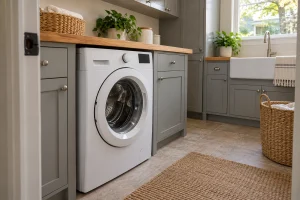
Washers do the hardest daily work of any appliance in a Bay Area home, and Maytag washers are among the most common ones we see: in garages in the avenues, in hallway closets in flats, in shared basement laundry rooms and in stacked pairs under a dryer. When a washer fails, there is usually a wet load inside and a pile of laundry beside it, so we put the diagnosis first and the guessing last.
A tub full of water after the cycle ends is the call we hear most. The pump may be jammed by a sock or coin, the drain hose may be kinked or pushed too far into the standpipe, the filter on a front-load machine may be packed, or the lid or door switch may be stopping the final stage. The article on a washer not draining gives the order of checks.
Weak filling can be a partly closed supply valve, a clogged screen at the hose end, a kinked hose or an inlet valve that no longer opens. In older buildings, low water pressure at the laundry tap adds to it. Our guide to a washer not filling describes it.
The lid switch, the lid lock, the drive coupling, the belt on some designs, the shifter and the motor are all candidates. A top-load washer that fills and then clicks without turning calls for a different test than a front-load washer that locks and then stops. Start with a washer not spinning.
A flashing lock indicator means the washer cannot confirm the lid or door is secured, or cannot release it. See lid lock flashing for how to separate a bent latch, an object on the lid, and a failed lock.
Off-balance loads, a floor that flexes, worn dampening or a loose drive can all make a washer jump during spin. The shaking and loud washer article explains which sounds mean what.
Moisture trapped behind the door gasket and in the drain filter makes a washer smell sour. See front-load washer odor.
Maytag washers use letter-number codes such as F9 E1, plus short letter codes like Sd and OFb. Each meaning here comes from our code pages.
The full list is in Maytag washer error codes. Photograph the display when a code appears.
The washer sits at the end of two supply hoses and one drain hose. If the drain hose is pushed too deep into a standpipe, it can siphon, and if it is kinked behind the washer, it will drain slowly. Hot and cold hoses connected to the wrong valves trigger the hose-reversed code. In stacked laundry closets, a washer tight against the wall flattens hoses and transmits vibration. In garages, the concrete floor may slope toward a drain and leave the machine tilted. Front-load washers add a door gasket, a drain filter and a detergent drawer that collect lint and residue. Top-load washers add the lid switch, the lid lock and the agitator or impeller drive.
Please do not open the cabinet, bypass the lid switch or reach into the drive area.
Switch the breaker off for burning smells, sparks, or water around the power cord. A washer that leaks should be shut off at the supply valves until it is repaired.
Maytag washers cover top-load agitator, top-load impeller and front-load designs, and the pumps, switches and boards differ among them. The label is usually inside the washer lid or around the door rim. Examples we see include the Maytag MTW6205RF top-load agitator washer, the Maytag MTW7200RF with an impeller, and the front-load Maytag MHW8630HC.
We confirm the symptom, test the water, lock and drive paths, and bring you a written estimate. Nothing is repaired without your approval. Learn more in the Maytag washers guide, then request a Maytag washer repair visit in San Francisco or elsewhere in the Bay Area.
We separate a lid or door switch problem from a drain problem from a drive problem. The washer will not spin if it believes the lid is open, if the tub still holds water, or if the drive path from the motor to the basket is not engaging. The article on a washer not spinning lists the order.
Usually it is an unbalanced load or an uneven floor, but a washer that walks across a laundry closet can damage the wall, the hoses and itself. Rebalance the load first. If it keeps happening with a normal load, we look at the suspension, the feet and the drive. See washer shaking and loud.
F9 E1 is a long-drain code, meaning the washer is taking too long to drain. F8 E1 is a long-fill code, meaning the water level is not changing. Both point to the water path, so check hoses and the drain first. The washer code overview lists more.
Yes, and also front-load washers. The drive, the seal and the pump are built differently in each, so the model number tells us what we are dealing with before we arrive.
No. We diagnose, give you a written estimate, and wait for your approval before repairing anything.
Maytag front-load and top-load washers in Bay Area homes and laundry rooms, with the full documented lineup, common faults, display codes and…
Maytag electric and gas cooktops repaired in Bay Area homes: dead zones, burners that click without lighting and touch control faults, with…
Drain, fill, heat, latch and control faults on Maytag dishwashers diagnosed in San Francisco and the Bay Area, with a written estimate…
Maytag electric and gas dryers diagnosed on site at your Bay Area home, from clogged vents and no-heat faults to worn belts,…
Over-the-range Maytag microwave repair in San Francisco and the Bay Area, from no-heat faults to vent fans, door latches and display codes.
Share a few details and we’ll confirm an appointment. Prefer to talk? Call us and we’ll help right away.