

Specialized Maytag Appliance Repair in San Francisco
Mon–Sat: 8:00 AM – 7:00 PM
A Maytag washer that leaves water in the tub usually has a hose, standpipe, filter or pump problem. Here is how to narrow it down and when to call.
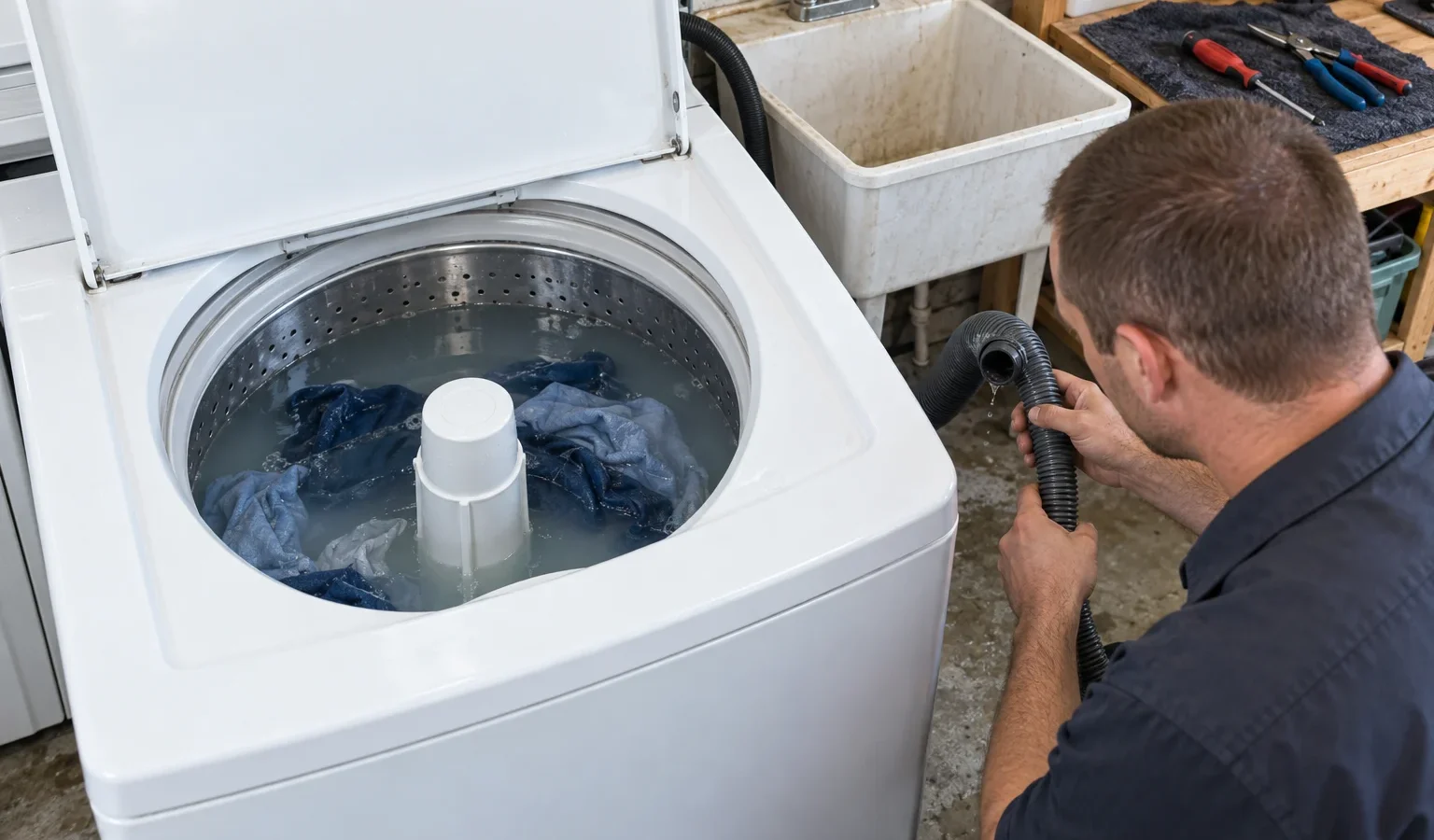
You open the lid or door and find the clothes sitting in a tub of grey water. The cycle stalled, or finished with the water still there. A Maytag washer that will not drain is one of the most common reasons a household in a flat or a small rental calls for help, and it is also one of the easiest problems to narrow down with a few careful looks from outside the machine.
Draining is a chain: the tub, a hose or internal passage, a pump, an outlet hose, and finally the standpipe or sink trap in the wall. The washer can only push water as fast as the weakest link allows. When the control sees that the water level has not fallen when it should, it stops and may show a long-drain message such as F9 E1, F21, Ld or drn. Those strings all say the same thing in different dialects: the washer cannot get rid of the water.
A drain hose pinched behind a washer pushed too far back is the classic. In closet laundry the hose bends around a corner and creases. A standpipe that is packed too tightly with the hose, or that has a small blockage from lint, makes water back up and gurgle. The washer looks broken when the building drain is the actual limit.
Coins, hair ties, tissue, small socks and pet hair all end up at the pump. Front loaders have a small drain filter near the bottom front that exists to catch exactly these items. Top loaders hide the same objects behind the cabinet. A pump that hums but does not move water is usually obstructed, while a pump that is silent may have failed or lost its power signal.
Sometimes the water is fine to drain, but the washer will not start the step. A door or lid that does not register as closed, or a lock that did not engage, can freeze the cycle with water still inside. This is why a drain complaint sometimes carries a door-lock code instead of a drain code.
If the filter door has no obvious access or the water keeps flowing from the washer while you work, stop. A tub full of standing water is heavy and messy, and tilting the washer is not a safe owner step.
Do not pour drain cleaner into the tub; it can sit in the pump and attack the seals. Do not reach into the pump area with a screwdriver, and do not open the back panel with the washer plugged in. Do not start another full load hoping it will push through. A washer that cannot drain will often overfill the tub with the next cycle and carry the problem across the floor and into the unit below, which matters a great deal in a stacked building.
On a front loader such as the MHW5500FW, standing water usually points at the drain filter, the pump or the gasket pocket that holds trapped items. The door often stays locked while water is present, which is a safety feature, not a fault. On a top loader such as the MTW6205RF, a lid lock that releases late can make a drain problem look like a lock problem and vice versa. Water that drains slowly but does drain often belongs to the hose or standpipe, while water that does not move at all leans toward the pump.
A washer that cannot drain will also refuse to spin, since spinning with a full tub would throw water. If your symptom is wet clothes at the end of the cycle without standing water, read the guide on a Maytag washer not spinning instead. If the drum fills fine but nothing leaves it, you are in the right place.
Laundry in older Victorian flats often shares one drain stack with a kitchen or another unit. A standpipe that was fine for decades can become the limiting factor when a new washer pumps faster than the old one. In garages in the avenues, a cold floor and a long hose run can combine with lint to form a partial blockage that a short test misses. In stacked closet laundry, the drain hose may rise higher than the washer and then fall, which makes it harder for the pump to push water along, and it should be checked before the pump is blamed.
When you contact us, tell us whether the water drains slowly or not at all, whether the sink in the same room is also slow, and what the display shows. Add the model number, which you can find using our guide on how to find a Maytag model number.
Book a visit if the filter and hose are clear and the water still stays, if the pump hums without moving water, or if the code returns after a reset. Our technician diagnoses before repairing, gives you a written estimate and starts nothing without your approval. Read how that works on the Maytag washer repair page, and see the types of machines we handle on the Maytag washers page. The full list of messages is in the article on Maytag washer error codes.
The control did not see the water level fall when expected, so it stopped. The usual reasons are a pinched hose, a blocked standpipe, an obstructed pump or a door or lid that did not register as closed.
Yes, if the washer is switched off and unplugged and you have a shallow pan and towels ready. Water will come out. Open it slowly and close it firmly. Stop if water keeps pouring or you cannot reach the filter.
Yes. If a nearby sink also drains slowly, the problem may be the shared line or the standpipe, and the washer is only showing it. A plumber may be needed for that part.
It can clear a one-time control hiccup. If the water still stays after one reset, the cause is physical or electrical and needs a diagnosis.
Not by itself. Most drain complaints come from a hose, filter or pump, and the written estimate after diagnosis shows what is involved before you decide.
Share a few details and we’ll confirm an appointment. Prefer to talk? Call us and we’ll help right away.