

Specialized Maytag Appliance Repair in San Francisco
Mon–Sat: 8:00 AM – 7:00 PM
A Maytag washer that fills and agitates but leaves clothes sopping has lost its spin. Balance, drain, lid or door signals, and the drive itself are the places to look.
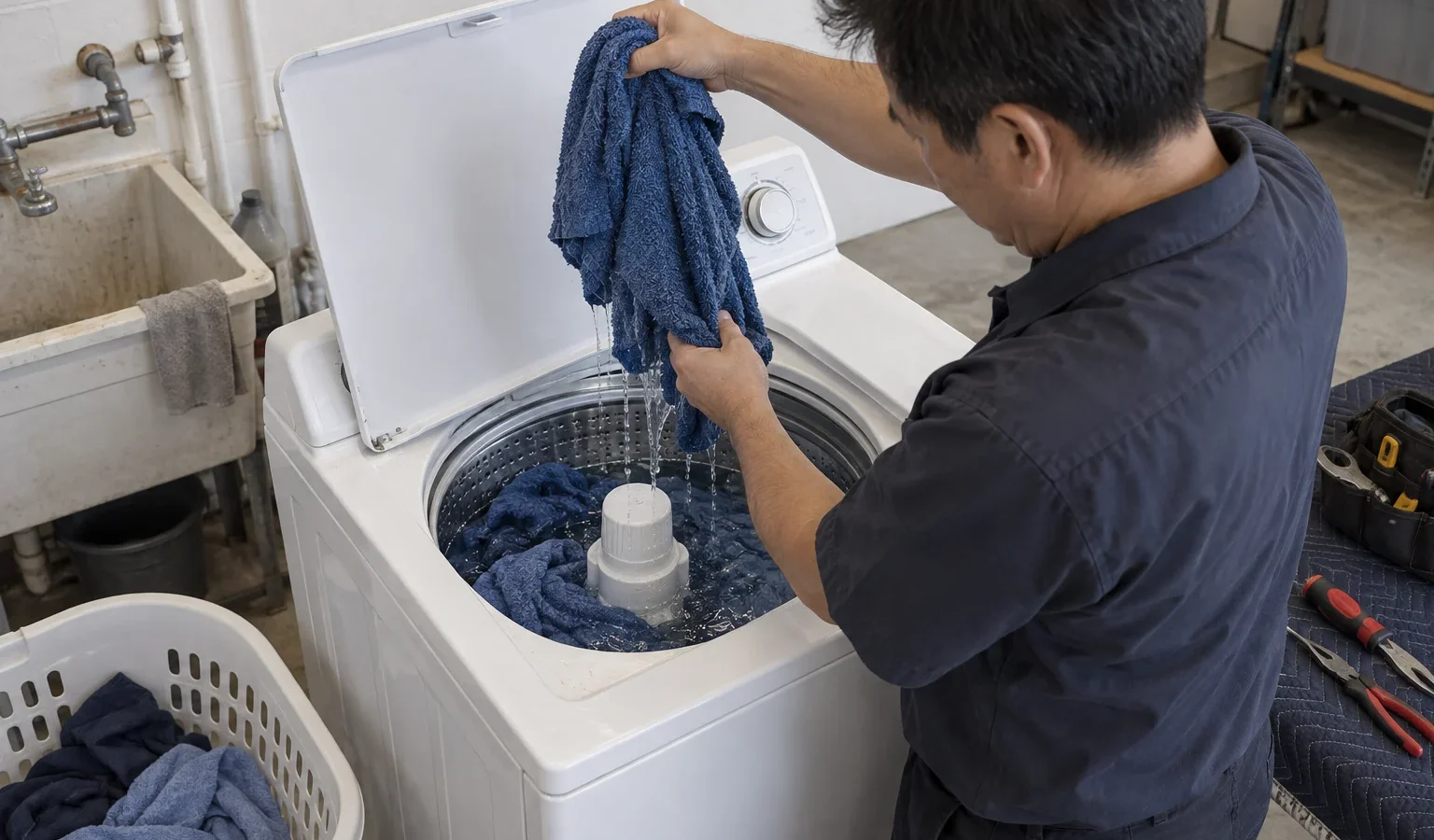
Few laundry problems are as maddening as lifting out a load that is dripping. Your Maytag washer filled, washed and perhaps drained, but the final spin never happened or was very weak. A spin needs several things in agreement: the water has to leave the tub, the lid or door has to report that it is closed and locked, the load has to be balanced, and the drive has to turn the basket. A fault in any one of those can leave you with a heavy, wet load.
Top-load washers, with an agitator or an impeller, and front-load washers fail to spin for overlapping but different reasons. On a top-load model the basket is moved through a gearcase or a drive system, and the lid switch must be closed. On a front-load model a belt or direct drive turns the drum, and the door must latch before spin begins. Some Maytag machines will pause and rock the drum to rebalance the load if they sense a lopsided mass, which looks like a failure if you walk away from it.
Start by redistributing the load. Stop the cycle, open the lid or door once drained, and spread the items. Remove anything that wraps, like sheets knotted into a rope, and avoid washing one heavy item alone. Select Drain and Spin to see whether the washer completes a spin once the load is even.
If water still sits in the tub, check the drain. Inspect the hose behind the washer for a kink and make sure it still sits in the standpipe without being pushed too far in. In a front-load model, clean the drain pump filter, a small access panel near the lower front; place a shallow tray and towels under it, because water will come out. Remove coins, hair ties and small socks, and replace the cap firmly.
Read the display. If a code or a light is shown, write it down. Then use one controlled reset: unplug the washer for a few minutes, plug it in again, and try Drain and Spin. If nothing changes, stop.
Do not reach into a spinning basket, do not defeat the lid switch with tape or a magnet, and do not pull the washer from the wall and tilt it onto its side with water inside. Do not force a locked front door open. If the door is locked with water behind it, wait for the washer to unlock or call for help; opening it quickly can send water across the floor. A burning smell or smoking motor means power off at the breaker.
San Francisco homes often put the washer in a closet, a basement or a garage, and each has its own traps. A washer on an uneven floor will shake itself out of the spin as soon as the drum accelerates, and one in a tight closet may have a drain hose crushed behind it. Stacked laundry in flats raises vibration when feet are not set. In older buildings, a standpipe with a poor trap or a shared stack can slow the drain enough that the washer waits and stops. A garage washer in a damp coastal neighborhood may also have rust at the lid hinge or a corroded electrical connection. We look at leveling, hoses and the drain path early in a visit.
Maytag washers vary a great deal between lines, and the label can be found under the lid, on the door rim or at the back, depending on the layout; how to find your Maytag model number shows the typical places. A top-load impeller like the Maytag MTW7200RF drives its basket differently from the front-load Maytag MFW7020RF, so the parts we bring change with the model.
If a balanced load drains and still will not spin, if a code returns, or if the motor hums with no turning, book a diagnosis. We test the drain, the lock, the sensors and the drive, give you a written estimate and wait for approval. See Maytag washer repair and Maytag washers.
The control may be limiting speed because of an off-balance load, suds or a high water temperature. Redistribute the load and use less detergent.
Occasionally yes, but repeated failure means the problem is real. Continuing to run it can strain the drive or the drain pump.
Not by itself. The door stays locked until water drains and the drum stops.
If vibration triggers the stop, leveling often helps. Adjust the feet until the washer does not rock.
Possibly, but not always. Drain, lock and balance issues are more common than a failed drive part.
Share a few details and we’ll confirm an appointment. Prefer to talk? Call us and we’ll help right away.